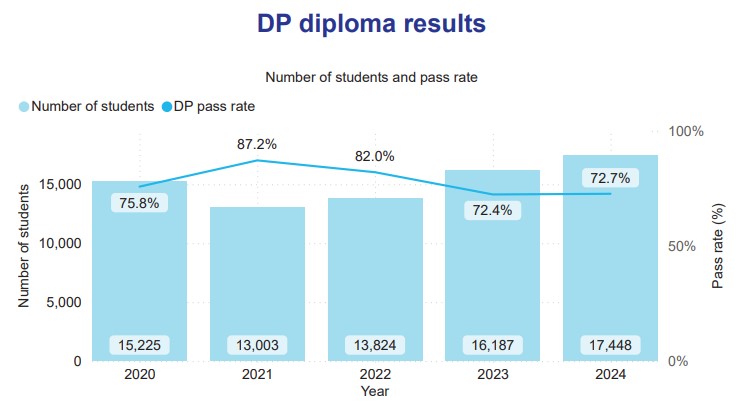
For IB students, the period between sitting exams and receiving results is often filled with calculations, speculation, and the anxious refreshing of forums. Understanding the “magic number”—the raw percentage required to achieve a Level 7—is crucial for setting realistic goals and managing university admission expectations.
While the International Baccalaureate Organization (IBO) only releases the official boundaries after all marking is complete, we can make highly accurate projections by analyzing the most recent data cycles. Based on the stabilization of grading standards observed in the May 2025 session, the IB Grade Boundaries 2026 are expected to follow a consistent, rigorous pattern, moving away from the fluctuations seen during the pandemic years.
At Easy Sevens Education, we believe that data beats anxiety. Below, we break down the projected boundaries for the 2026 cohort based on the latest verified data, helping you understand exactly what is required to secure your target score.
How Are 2026 IB Grade Boundaries Determined?
Before diving into the specific numbers for 2026, it is vital to understand the mechanism behind them. Grade boundaries are not fixed in advance; they are determined via a bell curve methodology after every exam session.
The IBO aims to maintain a consistent standard of achievement year over year. If a specific exam paper (e.g., Physics HL Paper 1) proves to be significantly more difficult than previous years, the grade boundaries will lower to ensure that students are not unfairly penalized. Conversely, if an exam is perceived as “easy,” the boundaries will rise.
Key Factors Influencing the 2026 Cycle
For students sitting exams in May 2026 or November 2026, three main factors will dictate the final cut-offs:
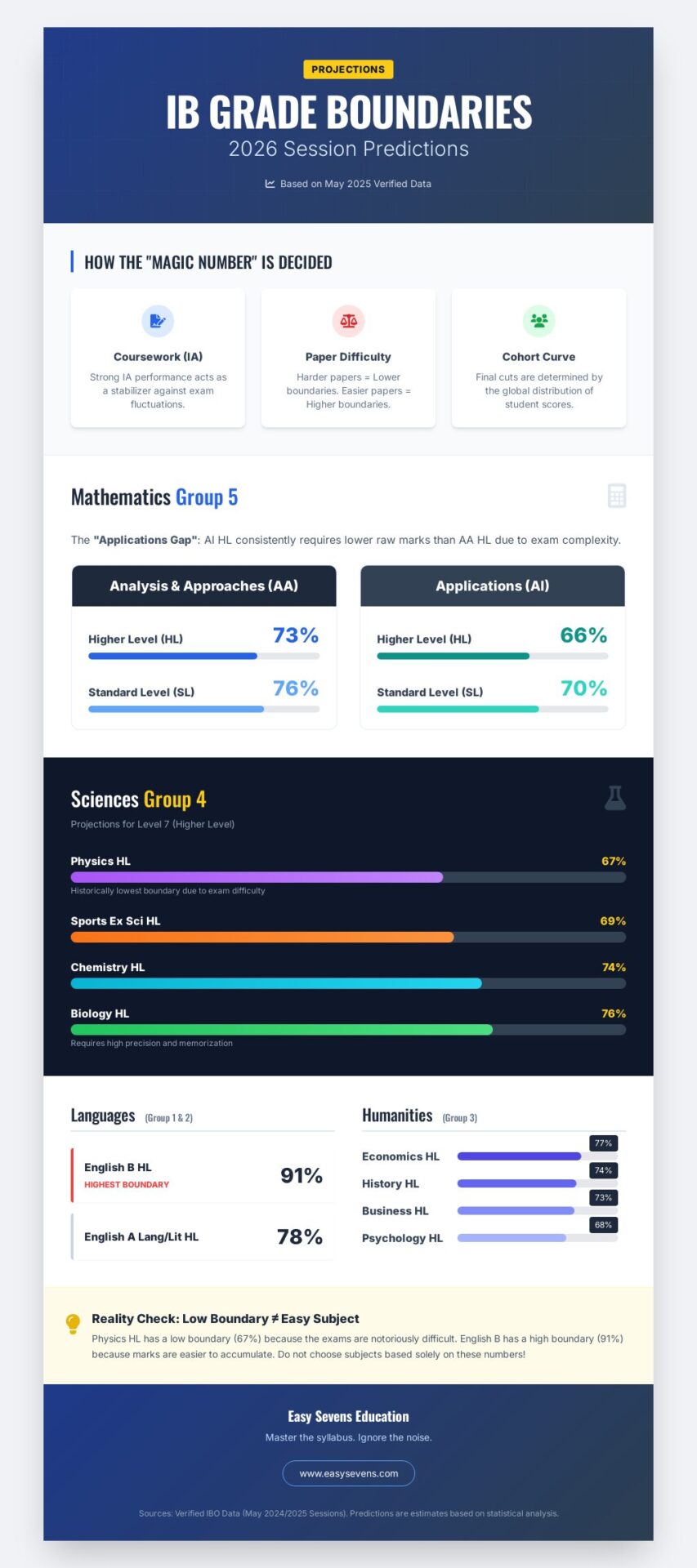
- Coursework Moderation: The Internal Assessment (IA) remains a stabilizer. Strong IA performance often buffers a student against high external exam boundaries.
- Paper Difficulty: Fluctuations in the difficulty of Math AA or Sciences papers are the primary driver of boundary shifts.
- Cohort Performance: The overall performance of the global student body creates the distribution curve.
Summary: Projected Grade Boundary Trends for 2026
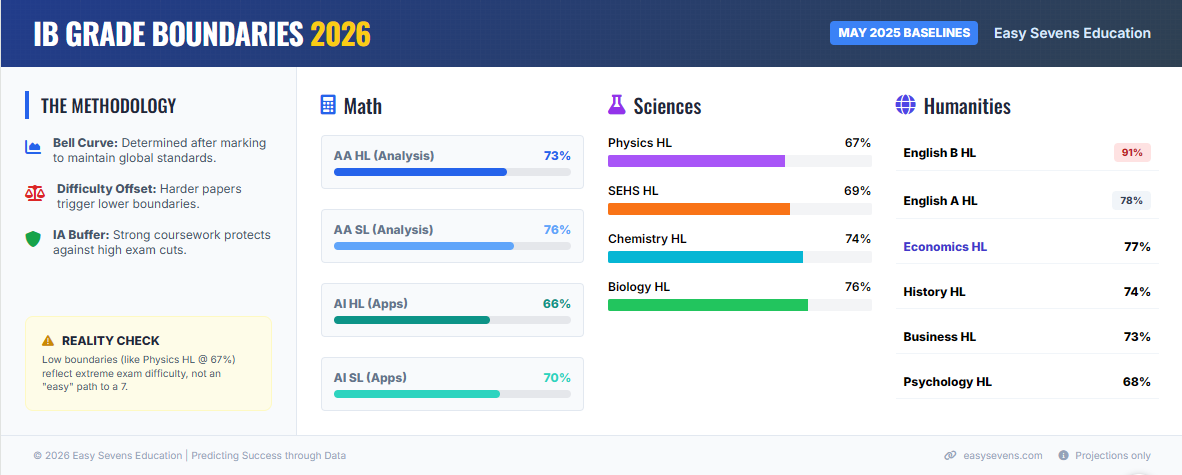
Based on the verified data from the May 2024 and May 2025 sessions, we have observed a “normalization” of boundaries. The grade inflation of 2021-2022 is over. The following table summarizes the difficulty tiers you can expect for 2026.
| Subject Group | Typical ‘Level 7’ Boundary | Difficulty Context |
|---|---|---|
| Group 1 (Language A) | 76% – 80% | High Raw Mark Requirement. Subjective marking requires high precision. |
| Group 3 (Individuals & Societies) | 70% – 77% | Moderate. History and Economics often have higher cut-offs than Psychology. |
| Group 4 (Sciences) | 67% – 76% | Variable. Physics usually has lower boundaries due to exam difficulty; Biology tends to be higher. |
| Group 5 (Mathematics) | 66% – 76% | Significant Split. Math AI HL often has lower boundaries than AA HL due to the nature of the questions. |
IB Nov 25 Grade Boundaries PDF
IB May 25 Grade Boundaries PDF
Subject-Specific Breakdowns for 2026
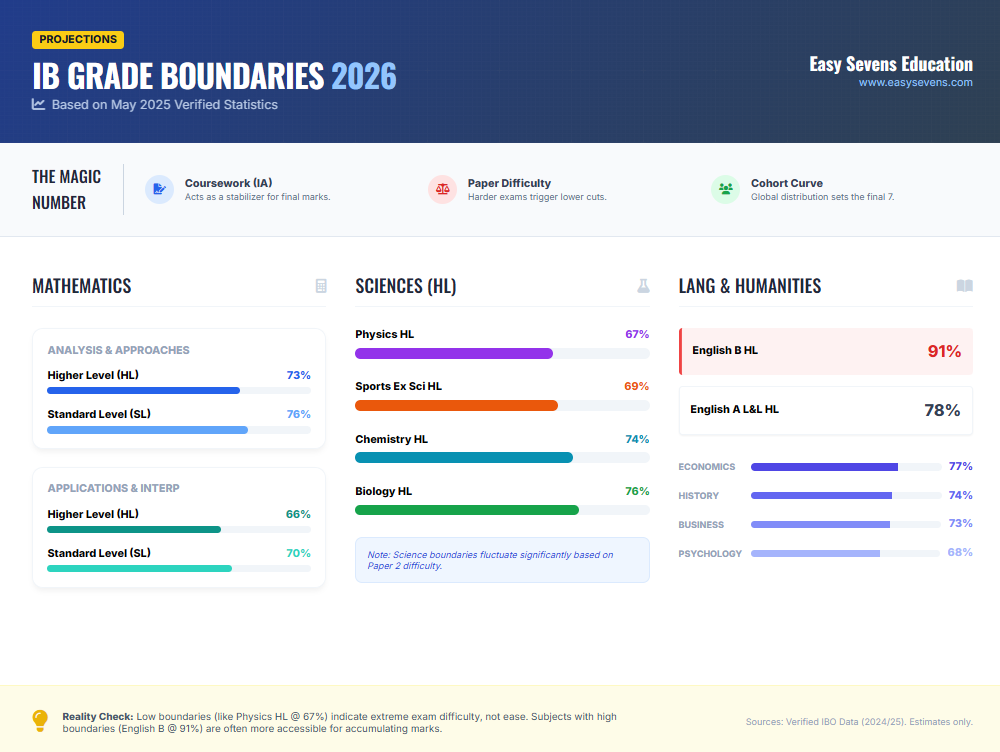
The following tables utilize the verified May 2025 Grade Boundaries as the most reliable baseline for predicting 2026 outcomes. These figures represent the lower boundary required to achieve the grade.
Group 4: Sciences (Biology, Chemistry, Physics)
Science subjects typically show the widest variance. Physics historically has the “lowest” boundary for a 7, reflecting the difficulty of the papers, whereas Biology requires a higher raw percentage for top marks.
| Subject & Level | Grade 7 (Min %) | Grade 6 (Min %) | Grade 5 (Min %) | Grade 4 (Min %) |
|---|---|---|---|---|
| Biology HL | 76% | 62% | 49% | 36% |
| Biology SL | 77% | 64% | 52% | 39% |
| Chemistry HL | 74% | 63% | 51% | 40% |
| Physics HL | 67% | 56% | 45% | 35% |
| Sports Ex Sci HL | 69% | 57% | 45% | 33% |
Data Source: May 2025 Grade Boundaries (Timezone 1 baselines).
Group 5: Mathematics (AA & AI)
Mathematics consistently causes the most anxiety regarding boundaries. Interestingly, the Applications & Interpretation (AI) HL course often sees lower boundaries for a 7 than Analysis & Approaches (AA) HL, suggesting students find the AI HL examinations particularly challenging to score highly in.
| Subject & Level | Grade 7 (Min %) | Grade 6 (Min %) | Grade 5 (Min %) | Grade 4 (Min %) |
|---|---|---|---|---|
| Math Analysis (AA) HL | 73% | 60% | 48% | 34% |
| Math Analysis (AA) SL | 76% | 62% | 48% | 33% |
| Math Apps (AI) HL | 66% | 55% | 44% | 32% |
| Math Apps (AI) SL | 70% | 55% | 42% | 29% |
Group 3: Individuals and Societies
Subjects like Economics and Psychology have seen boundaries creep upward over the last two cycles. To secure a 7 in 2026, students will likely need to score well above 70%, leaving little room for error in the extensive essay components.
| Subject & Level | Grade 7 (Min %) | Grade 6 (Min %) | Grade 5 (Min %) | Grade 4 (Min %) |
|---|---|---|---|---|
| Economics HL | 77% | 65% | 54% | 42% |
| Business Mgmt HL | 73% | 61% | 48% | 36% |
| Psychology HL | 68% | 57% | 45% | 33% |
| History (Europe) HL | 74% | 61% | 49% | 36% |
Group 1: Studies in Language and Literature
English A boundaries are notoriously high. Because these assessments are subjective, the IBO tends to keep the raw mark requirements strict to ensure that a ‘7’ represents truly exceptional analysis.
| Subject & Level | Grade 7 (Min %) | Grade 6 (Min %) | Grade 5 (Min %) | Grade 4 (Min %) |
|---|---|---|---|---|
| English A Lang/Lit HL | 78% | 65% | 53% | 40% |
| English A Lang/Lit SL | 78% | 63% | 51% | 36% |
| English B HL | 91% | 76% | 60% | 46% |
Related Resources
Understanding grade boundaries is just one piece of the puzzle. To ensure you fall on the right side of the curve, you need targeted preparation. At Easy Sevens Education, we provide comprehensive guides to help you master the content and exam technique. For specific advice on navigating the most difficult subjects, check out our guide on IB Maths AA vs AI to choose the right path for your strengths. If you are struggling with the sciences, our resource on Mastering the IB Physics Data Booklet is essential reading.
Frequently Asked Questions
When exactly will the IB Grade Boundaries 2026 be released?
Official grade boundaries are never released before results day. For the May 2026 session, schools will receive the detailed boundaries typically 24 hours after results are issued to students (early July). November 2026 boundaries will be available in early January 2027.
Do grade boundaries change significantly between Timezone 1 and Timezone 2?
There can be slight variations (usually 1-3%) between timezones. This is because different exam papers are used to maintain security. If the Timezone 2 paper is statistically more difficult than Timezone 1, the boundaries for TZ2 will be slightly lower to compensate.
Will the 2026 boundaries be higher than 2025?
We predict stability. The IBO has finished its “return to pre-pandemic standards.” Unless a specific exam paper in 2026 is unusually easy, boundaries should remain very close to the May 2025 figures listed above.
Does a low grade boundary mean the subject is easier?
No, usually the opposite. Physics HL often has a boundary of 67-68% for a 7, which is low compared to English B (91%). This reflects that Physics HL papers are notoriously difficult to score marks on, not that the subject is “easy” to get a 7 in.
Final Thoughts
While predicting the IB grade boundaries for 2026 can provide a helpful target, the best strategy is always to aim well above the cut-off. Relying on a boundary dropping by 1-2% is a risky strategy. Instead, focus on maximizing your Internal Assessment scores and mastering the core syllabus.
If you need support structuring your revision or want personalized guidance on how to secure a Level 7 in your specific subjects, our team at Easy Sevens Education is here to help.