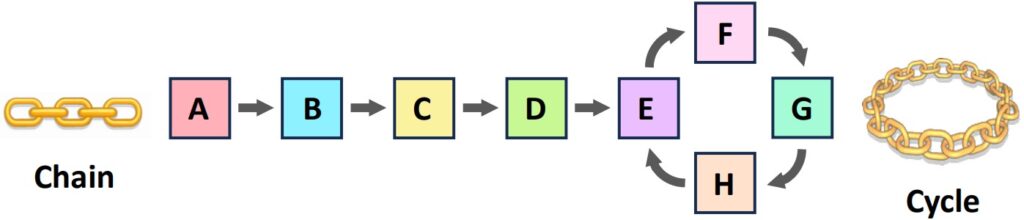

If you are staring at your IB Biology notes asking, "How hard is this test?", you are not alone. Cellular respiration is often cited as one of the most content-heavy topics in the syllabus. It involves complex biochemical pathways, specific locations within the mitochondria, and a lot of counting carbons and ATP molecules.
However, once you break it down into its four distinct stages, the complexity becomes manageable. Whether you are an SL student trying to grasp the basics or an HL student needing to master the electron transport chain, this guide covers the essential mechanisms of Cellular Respiration.
At Easy Sevens Education, we believe in simplifying the complex. Below, we walk through the process from the initial breakdown of glucose to the final production of ATP, ensuring you know exactly what happens and, crucially, where it happens.
The Fundamentals: ATP and Electron Carriers
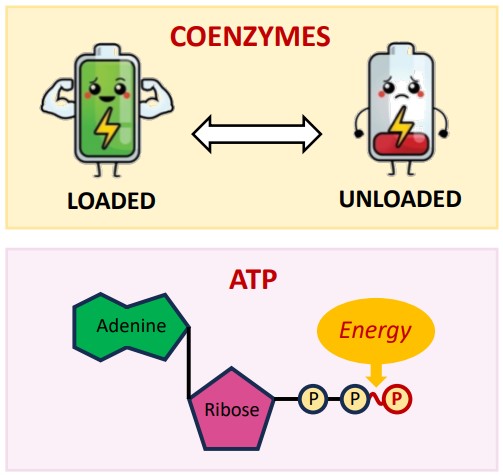
Before diving into the cycles, we must understand the currency of the cell: ATP (Adenosine Triphosphate). As discussed in our tutoring sessions, think of ATP as a charged battery. The energy is stored in the high-energy bonds between the phosphate groups.
When the cell needs energy for muscle contraction, active transport, or metabolism, it performs a hydrolysis reaction:
ATP + H_2O \rightarrow ADP + P_i + Energy
Respiration is simply the process of reattaching that phosphate group to ADP to recharge the battery. To do this, we need electron carriers. You will see NAD+ and FAD frequently. Remember the mnemonic OIL RIG:
- Oxidation Is Loss (of electrons/hydrogen).
- Reduction Is Gain (of electrons/hydrogen).
When NAD+ picks up hydrogen during respiration, it becomes reduced NADH. This molecule carries high-energy electrons to the final stage to generate ATP.
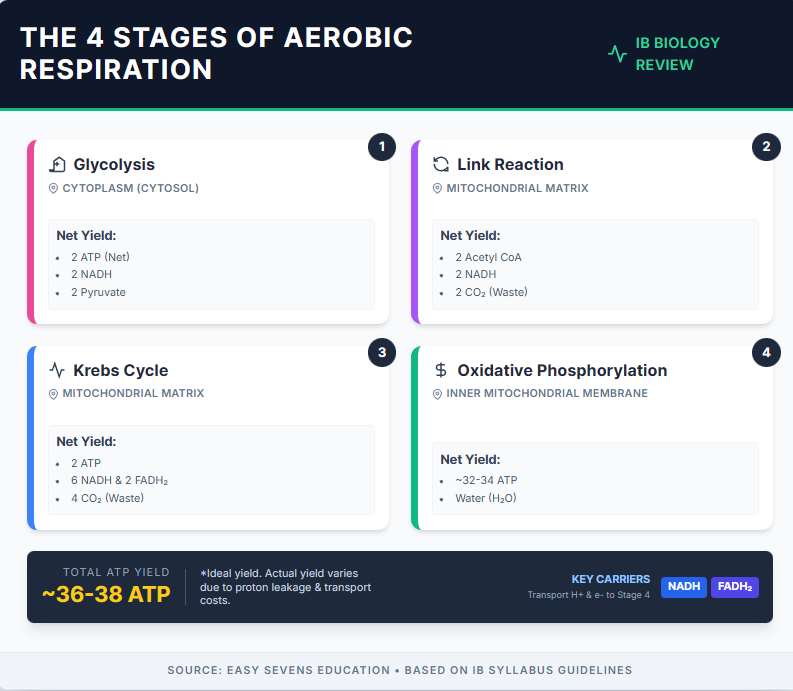
Quick Reference: The Four Stages of Aerobic Respiration
One of the most common mistakes in IB exams is mixing up the locations of these reactions. Use this comparison table to ensure you know the difference between the Matrix and the Intermembrane Space.
| Stage | Location | Main Event | Net Yield (per Glucose) |
|---|---|---|---|
| 1. Glycolysis | Cytoplasm (Cytosol) | Splitting Glucose into Pyruvate | 2 ATP, 2 NADH, 2 Pyruvate |
| 2. Link Reaction | Mitochondrial Matrix | Oxidation of Pyruvate to Acetyl CoA | 2 NADH, 2 CO2, 2 Acetyl CoA |
| 3. Krebs Cycle | Mitochondrial Matrix | Complete oxidation of Acetyl group | 2 ATP, 6 NADH, 2 FADH2, 4 CO2 |
| 4. Oxidative Phosphorylation | Inner Mitochondrial Membrane | ETC & Chemiosmosis | ~32-34 ATP, Water |
Deep Dive: Step-by-Step Guide
1. Glycolysis steps
Glycolysis literally means "sugar splitting" (glyco = sugar, lysis = splitting). It occurs in the cytoplasm and is an anaerobic process, meaning it does not require oxygen.
- Phosphorylation: Two molecules of ATP are used to add phosphate groups to glucose (C_6) , making it unstable. This creates Hexose Bisphosphate.
- Lysis: The unstable Hexose Bisphosphate splits into two 3-carbon compounds called Triose Phosphate.
- Oxidation: Hydrogen is removed from the Triose Phosphate (oxidation) and transferred to the carrier NAD+, forming NADH.
- ATP Formation: Four molecules of ATP are produced via substrate-level phosphorylation.
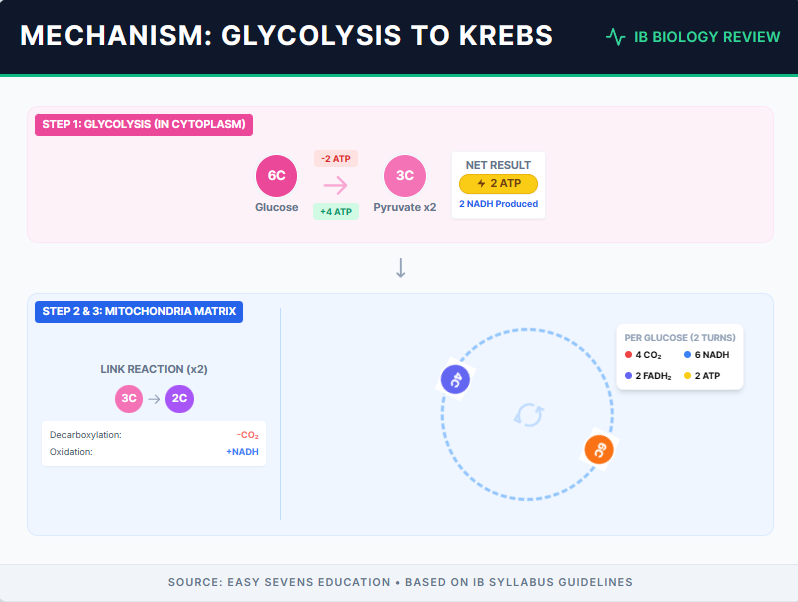
Result: Since we used 2 ATP to start and made 4 ATP, the net yield is 2 ATP and 2 Pyruvate molecules.
2. Link Reaction and Krebs Cycle
If oxygen is present, the Pyruvate enters the mitochondrial matrix via active transport. Here, the link reaction occurs:
- Decarboxylation: Carbon is removed from Pyruvate (C_3) as CO_2 .
- Oxidation: Hydrogen is removed to convert NAD+ into NADH.
- Formation of Acetyl CoA: The remaining 2-carbon acetyl group is attached to Coenzyme A.
The Krebs Cycle (or Citric Acid Cycle) follows immediately in the matrix:
- Acetyl CoA transfers its 2-carbon acetyl group to a 4-carbon compound (Oxaloacetate) to form a 6-carbon compound (Citrate).
- Through a series of reactions, Citrate is broken back down to Oxaloacetate.
- Yield per cycle: 2 CO_2 , 3 NADH, 1 FADH2, and 1 ATP.
Note: Because one glucose produces two pyruvates, the Link Reaction and Krebs Cycle happen twice per glucose molecule.
3. Oxidative Phosphorylation Explanation
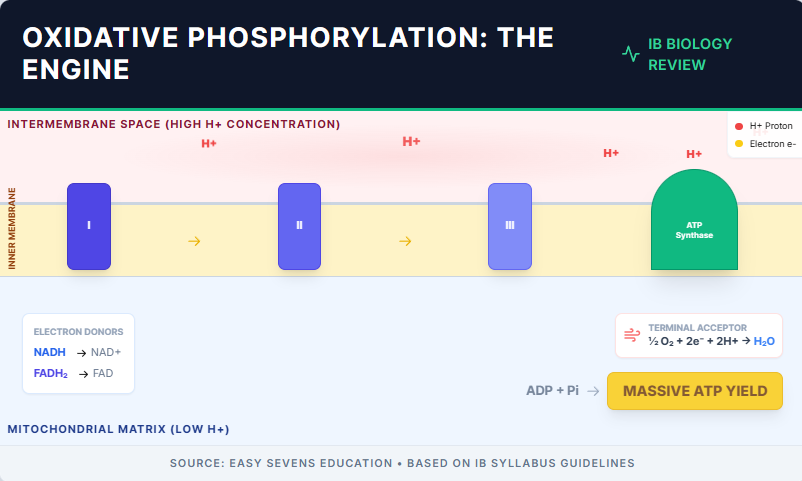
This is the final stage where the bulk of ATP is produced. It takes place on the inner mitochondrial membrane, including the cristae (folds) which increase surface area.
The Electron Transport Chain (ETC)
NADH and FADH2 produced in previous steps deliver their electrons to the chain. As electrons pass through protein carriers, they release energy. This energy is used to pump protons (H^+) from the matrix into the intermembrane space.
This creates a high concentration of protons in the intermembrane space—a proton gradient.
Chemiosmosis
The protons want to diffuse back into the matrix to equalize the concentration. However, they can only pass through a specific enzyme called ATP Synthase. The flow of protons rotates the enzyme, providing the energy to synthesize ATP from ADP and P_i .
Role of Oxygen
Oxygen acts as the terminal electron acceptor. It sits at the end of the chain, accepting electrons and protons to form water. Without oxygen, the chain backs up, and respiration stops.
\frac{1}{2}O_2 + 2e^- + 2H^+ \rightarrow H_2O
Related Resources
Understanding cellular respiration is often easier when you compare it to its counterpart: Photosynthesis. Many of the concepts, such as chemiosmosis and electron transport chains, are similar but reversed.
- To master the other side of the equation, read our guide on Photosynthesis Light Dependent Reactions.
- If you are struggling with the mathematical analysis of biological data, check our IB Biology Internal Assessment Guide for tips on data processing.
Frequently Asked Questions
Where exactly does the Krebs Cycle take place?
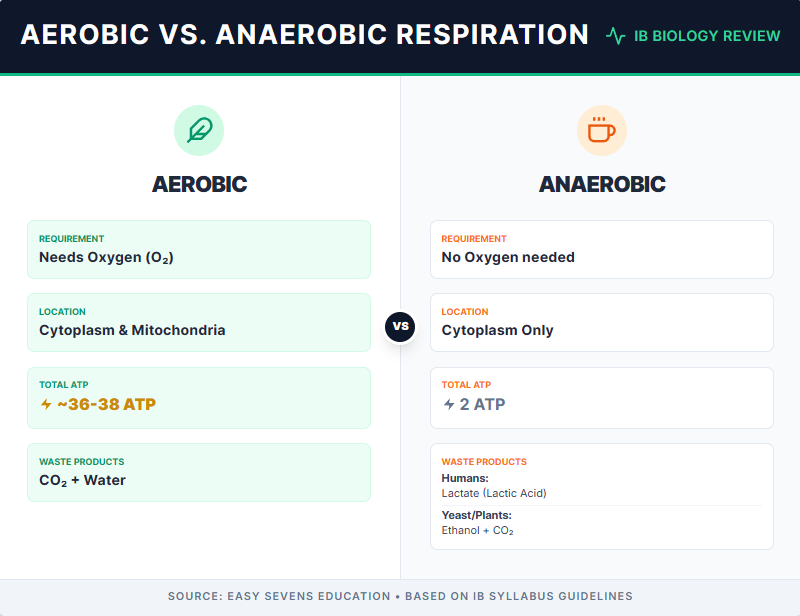
What is the difference between aerobic and anaerobic respiration in IB?
Why is the intermembrane space small?
The intermembrane space is very narrow to allow for the rapid accumulation of protons (H^+) . A smaller volume means the proton concentration gradient builds up much faster, making chemiosmosis more efficient.
What happens if oxygen is not present?
What is the role of NADH and FADH2?
They are electron carriers. They transport high-energy electrons from the breakdown of glucose (in Glycolysis and Krebs) to the Electron Transport Chain on the inner membrane, where that energy is converted into ATP.
Conclusion
Cellular respiration may seem intimidating with its enzymes and chemical formulas, but success lies in visualizing the pathway. Remember: Glucose is broken down to feed electrons to the ETC, which builds a gradient to power the ATP Synthase turbine. If you can track the carbon atoms and the electrons, you can master this topic.
If you are looking for more structured revision materials or need personalized guidance to ensure you hit that Level 7, explore our other resources at Easy Sevens Education.