
The Theory of Knowledge (TOK) essay is often cited by IB Diploma students as one of the most abstract and difficult components of the Core. Unlike a standard history or literature paper, the TOK essay requires you to navigate the “meta” level of learning—not discussing what we know, but how we know it.
With a strict 1,600-word limit and complex prescribed titles, a solid IB TOK essay structure is the difference between a mediocre grade and an “A”. Many students fall into the trap of simply listing facts. To succeed, you must adopt the persona of a philosopher and a critic, evaluating the very foundations of knowledge itself.
At Easy Sevens Education, we have guided countless students through this process. In this guide, we will break down exactly how to unpack your prompt, select your Areas of Knowledge (AOKs), and structure your arguments using insights from our expert tutoring sessions.
Unpacking the Prompt – The Foundation of Your Essay
Before you write a single word of your introduction, you must “unpack” the prompt. The IB provides six prescribed titles, and your first job is to define the key terms within the specific context of TOK. As noted in our expert sessions, the IB does not provide a dictionary definition for these terms; it is up to you to offer a sensible interpretation.

Defining Key Terms
Let’s look at a common structural requirement: analyzing “Context,” “Scientific Work,” and “Findings.” You cannot simply assume the reader knows what you mean by context. You must ask:
- Does “context” refer to the cultural background of the scientist?
- Does it refer to the technological limitations of the era?
- Does it refer to the “Community of Knowers” and the skepticism of the modern scientific community?
For example, if your essay focuses on the Human Sciences vs Natural Sciences TOK comparison, you might define “context” differently for each. In Natural Sciences, context might be the theoretical framework (e.g., Newtonian physics vs. Quantum mechanics). In Human Sciences, context often involves the socio-economic environment of the subjects being studied.
The Hypothetical Deductive Model
When structuring your essay, you must understand the methodology behind the AOKs you choose. In the Natural Sciences, we often utilize the Hypothetical Deductive Model. This is a normative model where we form a hypothesis and test its consequences.
The logic follows a structure similar to this:
H \implies O
Where H is the hypothesis and O is the observation. If O is false, then H must be false. However, as we discuss in our TOK essay outline strategies, this clean logic rarely applies perfectly to Human Sciences due to the inability to control variables.
Comparative Analysis – Natural vs. Human Sciences
A strong TOK essay often contrasts two Areas of Knowledge. A frequent and effective pairing is Natural Sciences and Human Sciences. Understanding the fundamental differences between these two is critical for your unpacking TOK prompts process.
Below is a comparison of how “Methodology” and “Findings” differ between these two AOKs, based on the concept of “Physics Envy”—the desire for softer sciences to achieve the mathematical precision of physics.
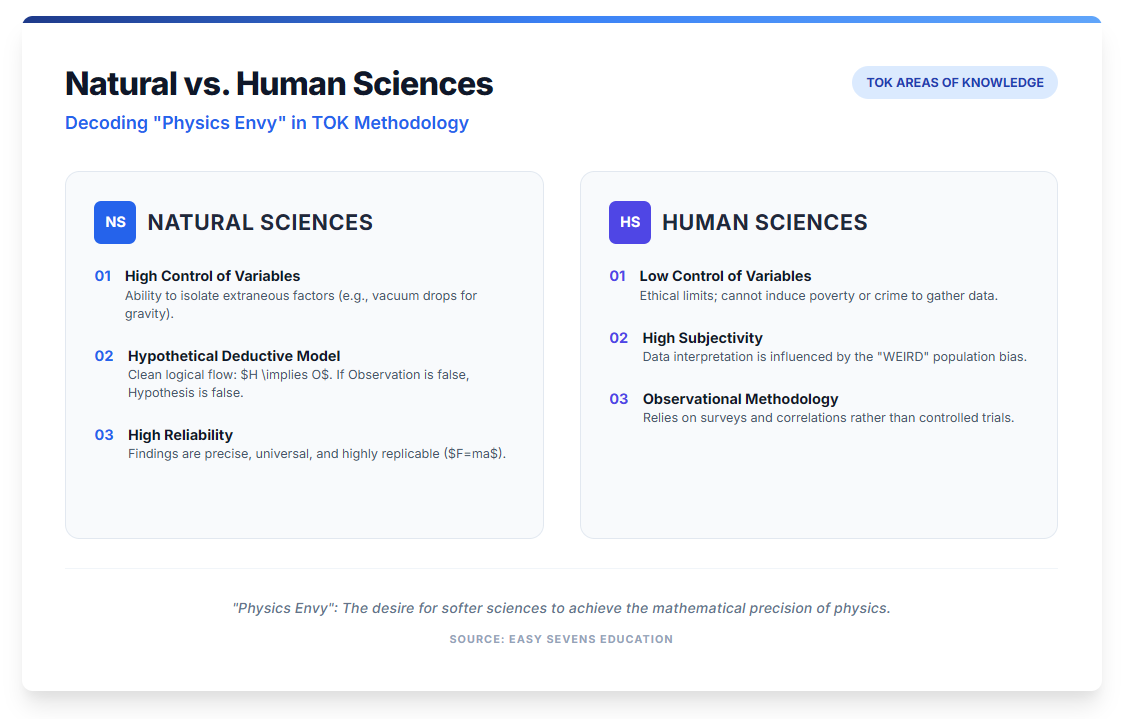
| Feature | Natural Sciences (e.g., Physics) | Human Sciences (e.g., Psychology/Economics) |
|---|---|---|
| Control of Variables | High. Can control extraneous variables (e.g., dropping a ball in a vacuum to remove drag). | Low. Difficult to isolate variables. You cannot ethically make a population poor to test crime rates. |
| Methodology | Experimental. Randomized Control Trials are the gold standard. | Observational. Relies on surveys, correlations, and interpreting existing data. |
| Interpretation of Data | Low subjectivity. Data is precise (e.g., $F=ma$). Findings are usually “True” or “False.” | High subjectivity. Data is open to interpretation (e.g., does poverty cause crime, or does lack of education cause both?). |
| Reliability | High replicability. | Lower replicability due to cultural context and the “WEIRD” population bias. |
The Ideal TOK Essay Structure
Now that you understand the concepts, how do you organize them into a coherent essay? The standard IB TOK essay structure should not be a continuous stream of consciousness. It requires a rigid framework of Arguments and Counter-arguments.
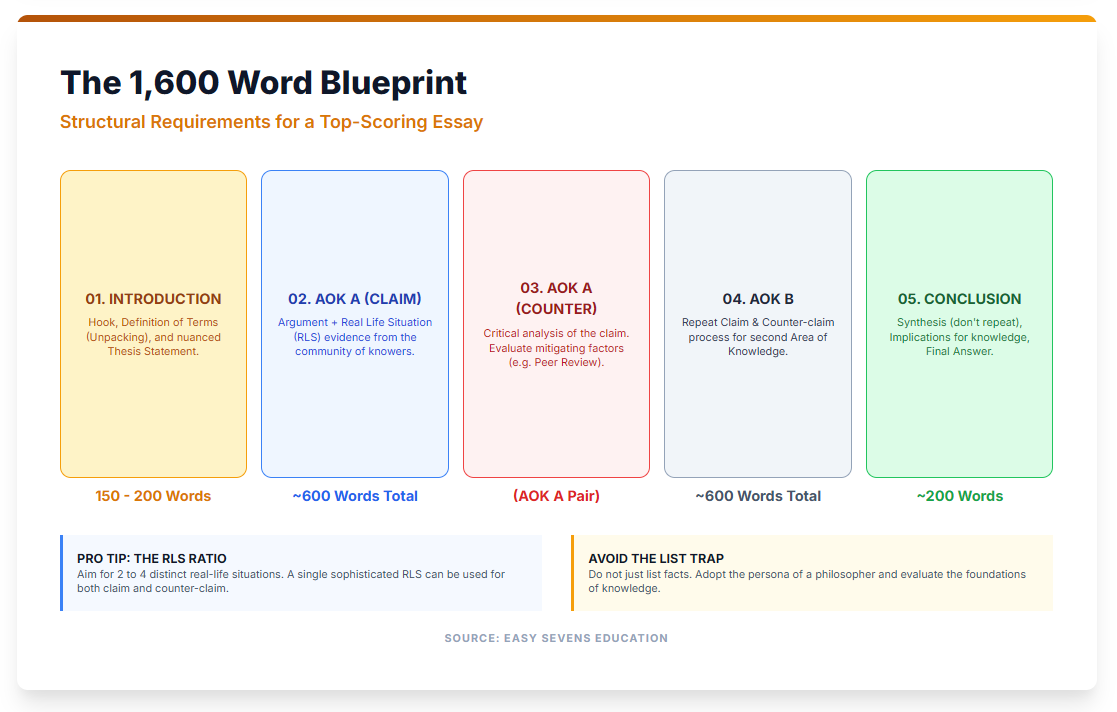
1. Introduction (approx. 150-200 words)
- Hook: Engage the reader with the tension inherent in the prompt.
- Definition of Terms: Explicitly state how you are interpreting the key words (Unpacking).
- Thesis Statement: A nuanced answer to the prompt. Avoid “Yes” or “No.” Instead, use “To a large extent…” or “While X is true in Natural Sciences, Y is true in Human Sciences.”
- Roadmap: Briefly mention the two AOKs you will discuss.
2. Body Paragraph 1: Area of Knowledge A (The Argument)
Focus on your first AOK (e.g., Human Sciences). Establish a claim that directly answers the prompt.
- Claim: “In the Human Sciences, the cultural context of the researcher significantly affects the findings.”
- Evidence (TOK Real Life Situations): Use a specific example. For instance, discuss the “WEIRD” population bias (Western, Educated, Industrialized, Rich, and Democratic). Psychology studies often rely on this specific demographic, skewing “universal” findings.
- Analysis: Explain why this supports your claim. Discuss concepts like “confirmation bias” or “interpretation.”
3. Body Paragraph 2: Area of Knowledge A (The Counter-Argument)
Critique your own claim. This is where you show the examiner you have critical thinking skills.
- Counter-Claim: “However, rigorous methodology can mitigate the impact of context.”
- Evidence: Discuss mechanisms like “Double-blind tests” or “Randomized Control Trials” (even if rare in Human Sciences) that attempt to strip away context.
- Link: Conclude this section by evaluating the strength of the argument vs. the counter-argument.
4. Body Paragraph 3 & 4: Area of Knowledge B (Argument & Counter-Argument)
Repeat the process for your second AOK (e.g., Natural Sciences).
- Contrast: Highlight how this AOK differs from the first. For example, in Natural Sciences, does context matter?
- Example: You might argue that gravity acts the same regardless of the scientist’s culture (F=ma).
- Counter-Example: However, the funding (context) determines which scientific work is undertaken (e.g., climate change research vs. pharmaceutical research).
5. Conclusion (approx. 200 words)
- Synthesis: Don’t just repeat your points. Synthesize the findings from both AOKs.
- Implications: What does this mean for the pursuit of knowledge?
- Final Answer: Direct reference back to the prompt title.
Related Resources
Structuring your essay is just the first step. To truly master the International Baccalaureate, you need comprehensive support across all your subjects. Whether you need specific IB Theory of Knowledge help or guidance on other coursework, we have resources available for you.
Explore more about how we support IB students: