
50 Proven IB Math AA & AI Internal Assessment (IA) Topics For 2026
Every year, thousands of International Baccalaureate (IB) Diploma students face the exact same moment of dread: opening a blank document and trying to decide on a mathematical exploration. The Internal Assessment (IA) accounts for 20% of your final IB Math grade in both Analysis & Approaches (AA) and Applications & Interpretation (AI). It is the single largest piece of independent work you control entirely outside the high-stress environment of final examination halls.
The core challenge most students face isn’t that they lack mathematical ability. Rather, it is selecting IB Math IA topics that are either far too broad—turning into a 20-page theoretical thesis—or far too simple, which guarantees a penalty under Criterion E (Use of Mathematics). A winning topic must balance mathematical rigor, personal engagement, realistic data collection, and clear communication.
Whether you are pursuing Math AA HL, Math AA SL, Math AI HL, or Math AI SL, this comprehensive guide provides 50 tested, high-scoring IB Math IA topic ideas for 2026, complete with research questions, recommended mathematical techniques, and a proven strategic framework to help you secure a Level 7 grade.
What Makes a Level 7 IB Math IA Topic in 2026?
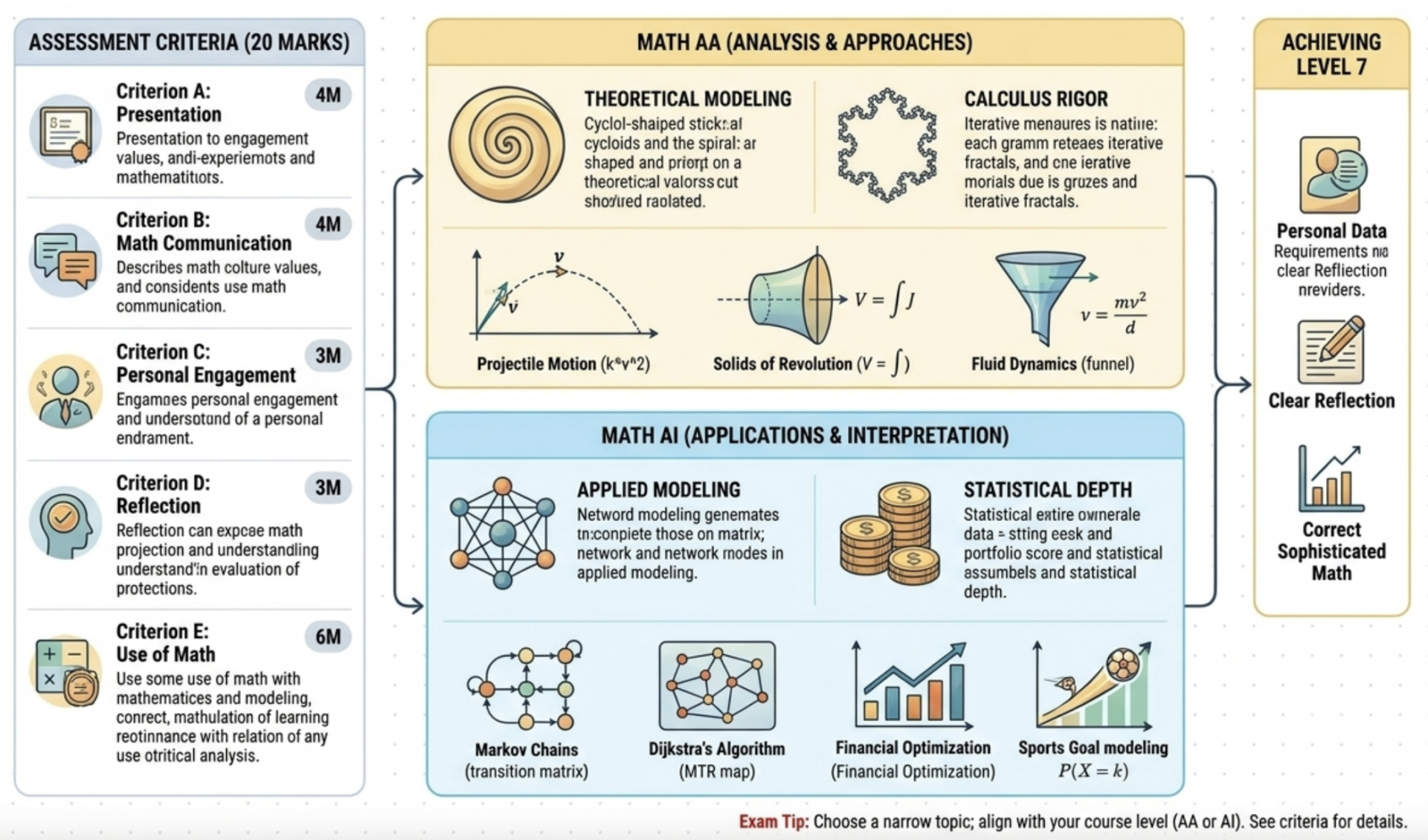
To score top marks, you must understand how the IB moderation panel evaluates your work. The IB Math Internal Assessment is graded out of 20 total marks, broken down into five distinct criteria:
- Criterion A: Presentation (4 Marks) – Evaluates the overall structure, organization, coherence, and logical flow of your exploration. A well-presented IA includes clear headings, labelled graphs, and formatted equations.
- Criterion B: Mathematical Communication (4 Marks) – Assesses your consistent use of appropriate mathematical notation, terminology, defined variables, and clear explanations of calculator steps or code.
- Criterion C: Personal Engagement (3 Marks) – Measures genuine curiosity and creative input. Examiners reward primary data collection, custom simulations, or personal twists on classic concepts over textbook copy-pasting.
- Criterion D: Reflection (3 Marks) – Requires critical evaluation throughout the paper—not just a single paragraph at the end. You must evaluate model limitations, discuss error sources, and explain alternative approaches.
- Criterion E: Use of Mathematics (6 Marks) – Evaluates the correctness, depth, and sophistication of the mathematics relative to your course level. The mathematics must be commensurate with the level of the course.
Examiner Warning: Choosing a topic that relies solely on basic high-school algebra (like calculating basic percentages or simple quadratic roots) caps your score in Criterion E at a maximum of 3 out of 6. Conversely, selecting theoretical physics far beyond your syllabus often leads to mechanical calculations without true personal understanding.
Comparing Math AA vs. Math AI Topic Criteria
The fundamental divide between Math AA (Analysis & Approaches) and Math AI (Applications & Interpretation) dictates how your topic should be structured. The table below outlines the core requirements for each pathway to ensure your topic aligns perfectly with IB expectations.
| Course Pathway | Primary Mathematical Focus | Ideal Exploration Types | Criterion E Benchmark |
|---|---|---|---|
| Math AA HL | Calculus, Differential Equations, Vectors, Complex Numbers, Proofs | Theoretical proofs, physical motion modeling, solid geometry, calculus of variations | Integration techniques, non-homogeneous ODEs, multivariable calculus basics |
| Math AA SL | Single-Variable Calculus, Trigonometric Functions, Geometry, Sequences | Optimization problems, periodic physical phenomena, geometric modeling | First derivatives, definite integrals, trigonometric transformations |
| Math AI HL | Advanced Statistics, Graph Theory, Markov Chains, Matrices, Differential Equations | Financial portfolio optimization, network routing, stochastic modeling, multi-factor regressions | Poisson distributions, transition matrices, coupled systems, Chi-Squared testing |
| Math AI SL | Applied Statistics, Probability, Exponential/Logistic Growth, Financial Mathematics | Real-world data correlation, exponential decay experiments, hypothesis testing | Pearson’s r, Spearman’s rank, Chi-Squared Independence, non-linear curve fitting |
50 Proven IB Math IA Topics for 2026
Below are 50 detailed topic ideas categorized by subject pathway and level. Each entry provides a refined research question alongside the primary mathematical tools required.
Category 1: IB Math AA HL Topics (Calculus, Proofs & Complex Algebra)
Math AA HL explorations require formal rigor, deep algebraic fluency, and sophisticated calculus techniques.
- 1. Projectile Motion with Quadratic Air Resistance: Modeling the trajectory of a basketball shot by setting up and solving first-order separable differential equations considering air resistance F_d = -kv^2.
- 2. Volume Optimization of Irregular Vessels: Using solids of revolution and definite integrals V = \pi \int_{a}^{b} [f(x)]^2 \, dx to calculate the precise capacity of a curved glass container and comparing it to experimental water displacement.
- 3. Fluid Dynamics & Torricelli’s Law: Deriving differential equations to model the drainage rate of liquid from conical vs. hemispherical funnels, validated with real video-tracking timing data.
- 4. Optimization via Lagrange Multipliers: Minimizing the material surface area required for a custom-designed ergonomic seating structure subject to a fixed volume constraint.
- 5. Proof & Applications of Euler’s Identity: Proving e^{i\pi} + 1 = 0 using Taylor Series expansion and exploring its geometrical representation via complex plane transformations.
- 6. Mandelbrot Set Boundary Dynamics: Investigating the convergence behavior of complex iterative functions z_{n+1} = z_n^2 + c and calculating approximate fractal dimensions.
- 7. 3D Vector Calculus in Satellite Signal Positioning: Calculating intersection coordinates of three directional vectors in 3D space to model GPS trilateration error margins.
- 8. The Brachistochrone Curve Problem: Applying the calculus of variations and parametric equations to prove that a cycloid represents the path of fastest descent under gravity.
- 9. Epidemic Outbreak Modeling via SIR Differential Equations: Constructing a system of non-linear differential equations \frac{dS}{dt}, \frac{dI}{dt}, \frac{dR}{dt} to predict peak infection rates during a seasonal flu outbreak.
- 10. Fourier Series & Harmonic Sound Decomposition: Decomposing complex musical instrument audio signals into infinite sums of sine and cosine functions.
- 11. Kepler’s Laws of Planetary Motion: Deriving elliptical orbital trajectories using polar coordinates and Newtonian gravitational calculus.
- 12. Newton’s Law of Cooling with Oscillating Ambient Temperature: Solving non-homogeneous differential equations where surrounding temperatures vary sinusoidally over time.
Category 2: IB Math AA SL Topics (Functions, Geometry & Single-Variable Calculus)
Math AA SL topics should focus on clear single-variable calculus, function transformations, and geometric optimization.
- 13. Sinusoidal Regression of Daylight Duration: Modeling annual daylight changes in Hong Kong vs. London using sine functions f(x) = a \sin(b(x-c)) + d and evaluating latitude effects.
- 14. Highway On-Ramp Curve Optimization: Applying first and second derivatives to determine optimal banking angles and curve radius to minimize centripetal vehicle slipping.
- 15. Logistic Growth Modeling of Endangered Species: Curve-fitting population growth data to a logistic function P(t) = \frac{L}{1 + e^{-k(t-t_0)}} to identify carrying capacity limits.
- 16. Topographical Mapping via Heron’s Formula: Calculating total irregular land parcel areas by sectioning terrain into non-right-angled triangles using satellite coordinate data.
- 17. The Golden Ratio in Modern Urban Architecture: Using logarithmic spirals and Fibonacci sequences to analyze structural aesthetic ratios in iconic Hong Kong skyscrapers.
- 18. Terminal Velocity of Falling Objects: Fitting exponential velocity curves to primary experimental drop data collected via high-speed phone camera tracking.
- 19. Harbor Tide Prediction for Maritime Navigation: Combining multiple sine functions to construct a accurate tidal prediction model for local container shipping lanes.
- 20. Catenary vs. Parabolic Bridge Cable Curves: Comparing hyperbolic cosine functions y = a \cosh(\frac{x}{a}) against standard quadratic polynomials in suspension bridge engineering.
- 21. Structural Efficiency of Honeycomb Hexagons: Proving geometrically why regular hexagons minimize perimeter-to-area ratios compared to triangles and squares.
- 22. Limits of Compound Interest: Evaluating financial accumulation as compounding frequency approaches infinity to derive \lim_{n \to \infty} (1 + \frac{1}{n})^n = e.
- 23. Bézier Curves in Vector Graphics: Utilizing cubic parametric equations to generate custom smooth typography curves in computer design software.
- 24. Damped Harmonic Motion of Simple Pendulums: Modeling mechanical energy loss over time using decay functions f(t) = A e^{-\gamma t} \cos(\omega t + \phi).
Category 3: IB Math AI HL Topics (Advanced Statistics, Graph Theory & Matrices)
Math AI HL students excel when utilizing multi-variable matrix operations, network algorithms, and inferential modeling.
- 25. Markov Chain Analysis of Board Game Dynamics: Constructing transition probability matrices and calculating steady-state eigenvectors to find winning probabilities in Monopoly.
- 26. Network Optimization via Dijkstra’s Algorithm: Mapping the Hong Kong MTR transit network as a weighted graph to calculate absolute shortest travel times between key hubs.
- 27. Google’s PageRank Matrix Algorithm: Building stochastic web link matrices and using power iteration methods to measure node authority scores.
- 28. Markowitz Portfolio Theory & Risk Minimization: Constructing variance-covariance matrices from stock return data to map an efficient investment frontier.
- 29. Multi-Factor Regression in Real Estate Valuation: Performing multiple linear regression with residual analysis and adjusted R^2 diagnostics to predict apartment prices.
- 30. Voting System Fairness & Arrow’s Theorem: Analyzing preference matrices across Borda Count, First-Past-The-Post, and Ranked Choice voting systems using historical election data.
- 31. Poisson Distribution in Sports Goal Modeling: Applying Poisson probability mass functions P(X=k) = \frac{\lambda^k e^{-\lambda}}{k!} to forecast European football match scorelines.
- 32. Travelling Salesman Problem for Logistics: Applying nearest-neighbor heuristics and graph theory to optimize multi-stop urban delivery routes.
- 33. Chi-Squared Independence Testing in Market Research: Conducting primary surveys and multi-way contingency table analysis to test consumer choices across demographics.
- 34. Game Theory & Oligopoly Price Strategy: Modeling competitive corporate pricing strategies using payoff matrices and Nash Equilibrium proofs.
- 35. Queueing Theory in Retail Service Lines: Utilizing Poisson arrival rates and exponential service times (M/M/1 queue models) to minimize customer wait times.
- 36. Voronoi Diagrams for Emergency Services Placement: Constructing spatial perpendicular bisector maps to optimize ambulance coverage zones across urban districts.
- 37. Time Series Forecasting of Currency Exchange Volatility: Utilizing autoregressive moving average models (ARIMA) to evaluate short-term exchange rate fluctuations.
Category 4: IB Math AI SL Topics (Applied Statistics & Real-World Modeling)
Math AI SL topics should leverage primary data collection, clear bivariate statistics, and accessible exponential modeling.
- 38. Caffeine Pharmacokinetics in the Human Body: Measuring personal cognitive reaction times post-coffee consumption and fitting exponential decay models C(t) = C_0 e^{-kt} to estimate half-life.
- 39. Sleep Duration vs. Academic Performance: Gathering primary student data to calculate Pearson’s correlation coefficient r and Spearman’s rank correlation between sleep hours and test scores.
- 40. Chi-Squared Goodness-of-Fit on Penalty Kicks: Analyzing professional football penalty kick directions to test whether shot placements follow a uniform distribution.
- 41. Newton’s Law of Cooling Experimental Verification: Collecting minute-by-minute temperature decay data of beverages in insulated vs. ceramic mugs to find cooling constants.
- 42. Depreciation Comparison of Electric vs. Petrol Vehicles: Curve-fitting 10-year secondary resale data using exponential decay vs. linear models.
- 43. Two-Sample t-Test on Reaction Times of Gamers: Conducting controlled experiments to test if action video game players exhibit statistically significant faster reaction times than non-gamers.
- 44. Probabilistic Breakdown of the Monty Hall Problem: Simulating thousands of trial rounds programmatically and using Bayes’ Theorem to prove why switching doors doubles win probability.
- 45. Logistic Modeling of Viral Content Dissemination: Tracking view counts of viral short videos over time and fitting sigmoidal growth curves.
- 46. Amortization Mechanics of Credit Card Debt: Modeling how minimum payment structures affect long-term interest accumulation using compound interest formulas.
- 47. Geometric Probability in Dartboard Aiming Strategies: Calculating target area probability ratios to determine optimal aiming coordinates for amateur dart throwers.
- 48. Acoustic Frequencies in Musical Tuning: Measuring audio frequencies across piano octaves using sound spectrum software to prove exponential frequency relationships f_n = f_0 \cdot 2^{n/12}.
- 49. Social Media Follower Retention Dynamics: Fitting logarithmic functions to measure user retention curves following major online content publishing events.
- 50. Standard Normal Distribution of Standardized Test Scores: Calculating Z-scores, standard deviations, and percentile rankings from public educational assessment data.

How to Turn a Topic Idea into a 14-Page Exploration
Once you select an initial concept, follow this step-by-step process to develop it into a high-scoring paper:
- Refine to a Single Research Question: Ensure your title is narrow and measurable. Replace generic titles like “Math in Basketball” with specific questions like “To what extent can a separable differential equation considering quadratic air resistance accurately predict free-throw trajectories for high-school athletes?”
- Perform a “Mini-Math Check”: Before writing your introduction, test the primary calculations on scratch paper or a spreadsheet. Ensure your data doesn’t produce undefined values or trivial linear fits.
- Collect or Clean Your Dataset: If using primary data, collect at least 30 measurements to satisfy statistical validity. If using secondary data, document your source filtering process clearly.
- Structure Your Document: Set up your template with standard margins, consistent equation numbering, and clear section headings: Introduction & Rationale, Methodology, Mathematical Analysis, Critical Reflection, and Conclusion.
Related Resources
To further refine your IB Mathematics preparation and explore key concepts needed for your Internal Assessment, explore our dedicated study guides and tutoring services:
- Master statistical analysis concepts for your AI exploration with our guide on Measures of Central Tendency: Mean, Median & Mode in IB Math.
- Get personalized, 1-on-1 feedback on your draft from expert tutors by visiting our IB Math Tutoring Services.
- Browse through our latest subject guides and revision strategies on the Easy Sevens Education IB Blog.
Frequently Asked Questions (FAQ)
How long should an IB Math IA be in 2026?
The IB official guidelines recommend an exploration length between 12 and 20 pages. Most Level 7 IAs land between 14 and 18 pages. While there is no strict word count, exceeding 20 pages often leads to penalties under Criterion A (Presentation) due to a lack of conciseness.
Do I need to collect primary data to score a 7?
No, primary data is not strictly required. However, collecting primary data makes demonstrating Criterion C (Personal Engagement) much easier. If you use secondary data, you must clean, transform, or combine datasets in a unique way to demonstrate personal engagement.
Can I use complex math outside my syllabus level?
You can, but proceed with caution. Criterion E evaluates whether the mathematics is understood and owned by the student. Using advanced university-level math that you cannot clearly explain usually results in lower communication and mathematical usage marks than mastering concepts directly aligned with your course level.
What is the difference between a Math AA IA and an AI IA?
Math AA IAs prioritize analytical proofs, theoretical calculus, geometric derivations, and formal algebraic transformations. Math AI IAs focus heavily on practical modeling, statistical inferential testing, technology integration, graph theory, and real-world data processing.