

Guide to Ionic and Covalent Bonds
Atoms rarely exist in isolation. In the world of chemistry, they connect in myriad ways to form the substances that make up our universe, from the water we drink to the DNA in our cells. In this comprehensive guide, we will explore IB Chemistry Ionic and Covalent Bonds in deep detail. From the electrostatic attractions found in rigid crystalline lattices to the complex three-dimensional geometries predicted by the VSEPR model, we will break down the essential concepts you need to know. Whether you are aiming for a 7 on your final exam or just trying to wrap your head around intermolecular forces, Easy Sevens Education is here to help you master the material. Let’s dive in.
The Ionic Model: Cations, Anions, and Electrostatic Attraction
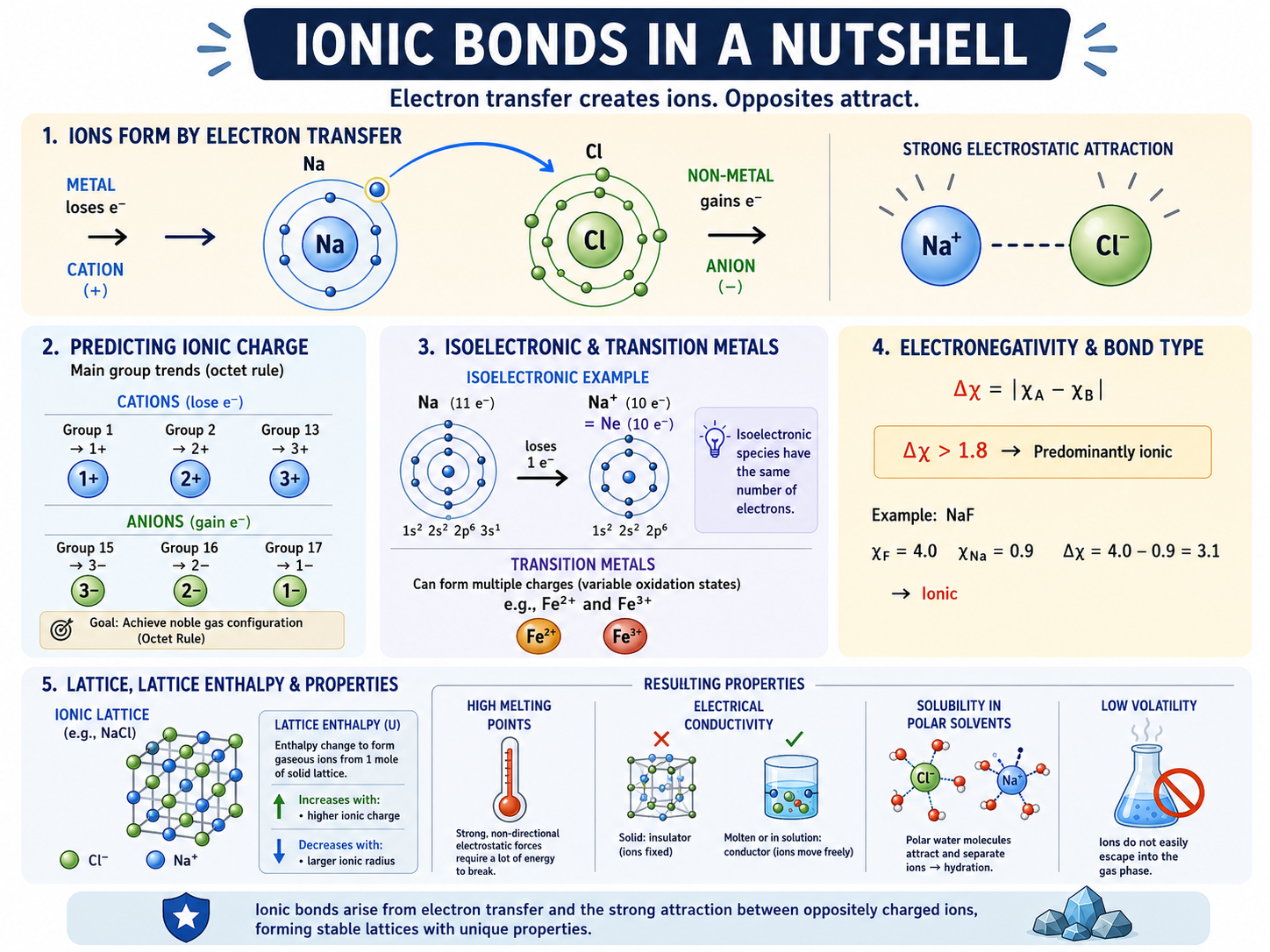
Ionic compounds are fundamentally characterized by the transfer of electrons and the resulting strong electrostatic attractions between oppositely charged ions. When metal atoms (like sodium or magnesium) lose electrons, they undergo a process called oxidation to form positively charged ions called cations. Conversely, when non-metal atoms (like chlorine or oxygen) gain electrons, they undergo reduction to form negatively charged ions called anions.
Predicting Ionic Charge and Isoelectronic Species
The periodic table is your most reliable tool for predicting the charge of an ion. Main group elements typically gain or lose electrons to achieve a stable, noble gas electron configuration—a principle widely known as the octet rule. For instance:
- Elements in Groups 1, 2, and 13 form 1+, 2+, and 3+ cations, respectively.
- Elements in Groups 15, 16, and 17 form 3-, 2-, and 1- anions, respectively.
When a neutral sodium atom (Na) loses its single valence electron, it becomes Na^+, adopting the exact electron configuration of the noble gas neon (1s^2 2s^2 2p^6). Because Na^+ and Neon have the exact same electron configuration, they are described as isoelectronic species.
Transition metals behave a bit differently. Because their 4s and 3d sublevels are very close in energy, they can lose different numbers of electrons to form multiple stable ions with variable oxidation states. For example, iron can commonly form both Fe^{2+} and Fe^{3+} ions.
Electronegativity and the Bonding Continuum
How do we know if a bond between two elements is ionic? The most reliable method is to calculate the difference in electronegativity (\Delta \chi) between the two bonding atoms. Electronegativity is an atom’s ability to attract a pair of covalently bonded electrons. Using the Pauling scale, if the difference in electronegativity is greater than 1.8 (\Delta \chi \gt 1.8), the bond is considered predominantly ionic.
For example, in Sodium Fluoride (NaF), the electronegativity of Fluorine is 4.0 and Sodium is 0.9. The difference is 4.0 – 0.9 = 3.1, firmly placing NaF in the ionic bonding category.
Lattice Enthalpy and Physical Properties of Ionic Compounds
In solid form, ionic compounds don’t exist as discrete, individual molecules. Instead, they form a massive, continuous three-dimensional network known as a lattice structure. The chemical formula you see (like NaCl) is an empirical formula; it simply tells us the lowest whole-number ratio of ions in this giant lattice.
Furthermore, the strength of the ionic bonds within this lattice is measured by lattice enthalpy. This is defined as the standard enthalpy change that occurs on the formation of gaseous ions from one mole of the solid lattice. Lattice enthalpy increases with higher ionic charge and decreases with a larger ionic radius (due to lower charge density).
Because these electrostatic forces are non-directional (they attract in all directions) and extremely strong, ionic compounds possess distinct physical properties:
- Low Volatility & High Melting Points: It takes a massive amount of thermal energy to break the rigid lattice, meaning they rarely vaporize and melt at very high temperatures.
- Electrical Conductivity: Solid ionic compounds are excellent insulators because their ions are locked tightly in place. However, when molten (melted) or dissolved in an aqueous solution, the crystal lattice breaks apart. The ions become free to move, allowing the substance to conduct electricity.
- Solubility: Ionic compounds are generally soluble in polar solvents like water. The partial charges on the water molecules attract the individual ions, effectively pulling them out of the lattice and surrounding them in a process called hydration.
The Covalent Model: Sharing Electrons and Lewis Formulas
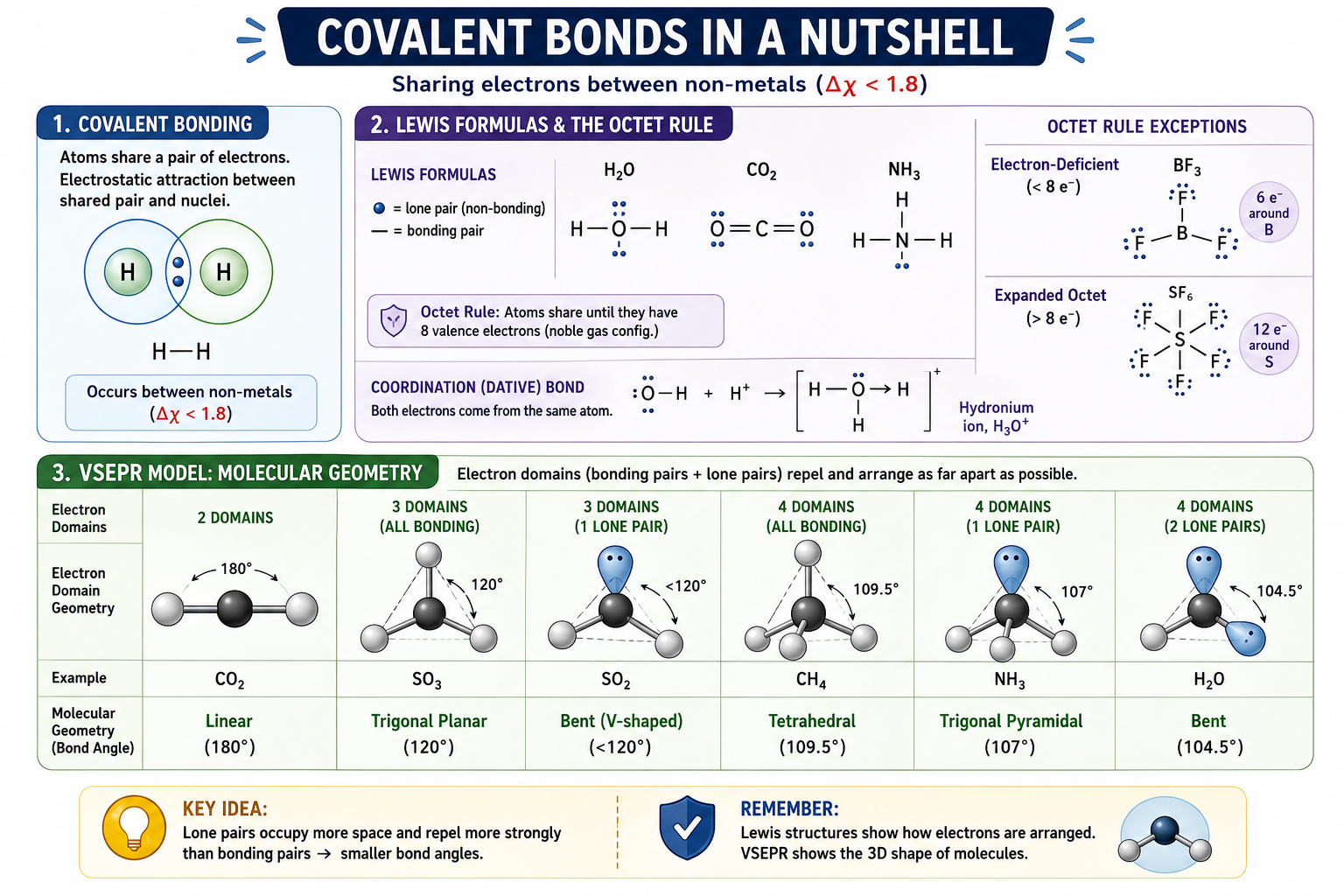
While ionic bonds involve the total transfer of electrons, covalent bonds are formed by the electrostatic attraction between a shared pair of electrons and the positively charged nuclei of the bonded atoms. This type of bonding typically occurs between non-metal atoms where the electronegativity difference is less than 1.8 (\Delta \chi \lt 1.8).
Lewis Formulas and the Octet Rule
To visualize covalent molecules, chemists use Lewis formulas (or Lewis structures). These two-dimensional diagrams show all valence electrons, arranging them into bonding pairs (represented by lines) and non-bonding pairs (represented by dots, also known as lone pairs). The driving force behind these arrangements is the octet rule, where atoms share electrons until they achieve a full outer shell of eight valence electrons.
However, there are notable exceptions to the octet rule that you must know for IB Chemistry:
- Electron-Deficient Molecules: Elements in Groups 2 and 13, like Beryllium and Boron, can form stable compounds with fewer than eight valence electrons. For example, Boron trifluoride (BF_3) has only 6 valence electrons around the central boron atom.
- Expanded Octets: Elements in Period 3 and beyond (like Sulfur and Phosphorus) can hold more than eight valence electrons by utilizing empty d-orbitals.
We also frequently encounter coordination bonds (sometimes called dative bonds). In a standard covalent bond, each atom donates one electron to the pair. However, in a coordination bond, both electrons in the shared covalent bond originate from the exact same atom. A classic example is the formation of the hydronium ion (H_3O^+), which forms when a water molecule donates a lone pair to bond with a hydrogen ion (H^+).
The VSEPR Model: Predicting Molecular Geometry
Lewis formulas are flat, but real molecules exist in 3D space. The Valence Shell Electron Pair Repulsion (VSEPR) model allows us to predict the three-dimensional shape of a molecule based on a simple premise: electron domains (both bonding pairs and lone pairs) negatively repel each other and will arrange themselves as far apart as physically possible around a central atom.
Here are the primary electron domain geometries required for your IB exams:
- 2 Domains (Linear): Electron domains push each other to opposite sides, resulting in a bond angle of 180^\circ. Example: Carbon dioxide (CO_2).
- 3 Domains (Trigonal Planar): Domains form a flat triangle with bond angles of 120^\circ. If one of those three domains is a lone pair, the molecular geometry becomes bent (or V-shaped) with an angle slightly less than 120^\circ. Example: Sulfur dioxide (SO_2).
- 4 Domains (Tetrahedral): The domains form a 3D pyramid with a triangular base, resulting in bond angles of 109.5^\circ. Example: Methane (CH_4).
It is crucial to remember that non-bonding (lone) pairs are pulled closer to the central nucleus and therefore occupy more space than bonding pairs, resulting in greater repulsion. This is why Ammonia (NH_3), which has 3 bonding pairs and 1 lone pair, takes on a trigonal pyramidal shape with a reduced bond angle of 107^\circ. Water (H_2O), which has 2 bonding pairs and 2 lone pairs, is bent with an even smaller angle of 104.5^\circ.
Concept Summary: Ionic vs. Covalent Properties
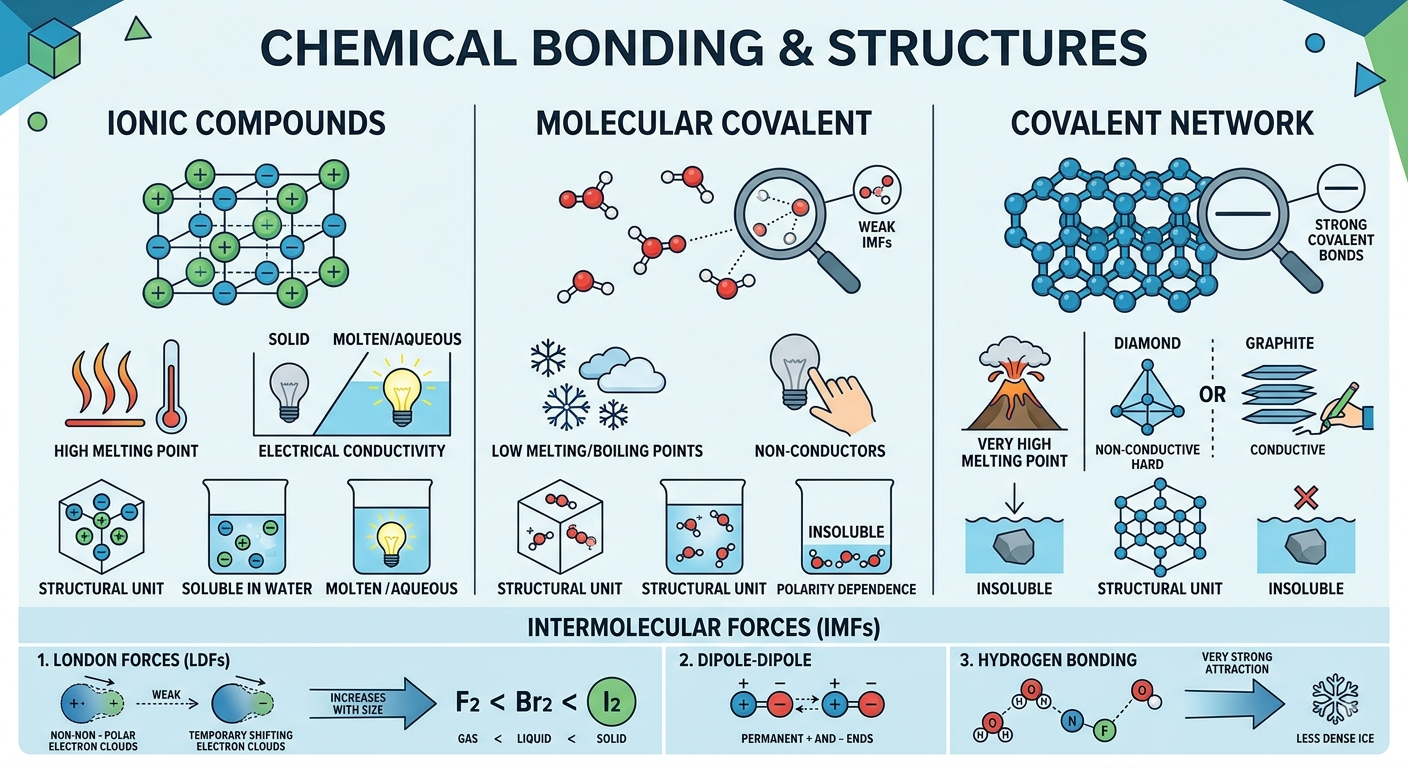
To help you prepare for Paper 1 and Paper 2, use this data comparison table to quickly recall the fundamental differences between the three main types of bonding structures.
| Structural Feature | Ionic Compounds | Molecular Covalent | Covalent Network |
|---|---|---|---|
| Basic Unit | Positive and negative ions | Discrete molecules | Atoms in a continuous lattice |
| Forces to Overcome on Melting | Strong electrostatic attractions (ionic bonds) | Weak intermolecular forces (IMFs) | Strong covalent bonds |
| Melting/Boiling Points | High (Solid at room temp) | Low (Often gases or liquids) | Very High (Solid at room temp) |
| Electrical Conductivity | Only when molten or dissolved (aqueous) | Non-conductors (insulators) | Non-conductors (Exception: Graphite/Graphene) |
| Solubility in Water | Generally high (soluble) | Depends on molecular polarity | Insoluble |
Intermolecular Forces: The Glue Between Molecules
Inside a covalent molecule, atoms are held together by incredibly strong intramolecular covalent bonds. But what holds one individual molecule to another? These are called intermolecular forces (IMFs), and they dictate physical properties such as boiling points, melting points, and volatility. When you boil water, you are not breaking the covalent bonds between Hydrogen and Oxygen; you are breaking the IMFs between the separate water molecules. There are three main types of IMFs.
1. London (Dispersion) Forces (LDFs)
LDFs are the weakest type of IMF but they exist between all molecules, whether polar or non-polar. They occur because electrons are constantly in motion. At any given nanosecond, the electron cloud might lean to one side, creating a temporary, instantaneous dipole. This temporary dipole can then induce a similar dipole in a neighboring molecule, causing a brief electrostatic attraction.
The strength of LDFs increases with molecular size and mass because a larger electron cloud is more easily distorted (it has a greater polarizability). For example, if we look at Group 17 halogens, Fluorine (F_2) is a gas, Bromine (Br_2) is a liquid, and Iodine (I_2) is a solid at room temperature. Their boiling points increase down the group entirely due to their increasing LDF strength.
2. Dipole-Dipole Forces
When a molecule is polar (meaning its bond dipoles do not geometrically cancel each other out), it has a permanent net dipole moment. The partially positive end of one molecule is permanently attracted to the partially negative end of another. These forces are stronger than LDFs. For example, Hydrogen Chloride (HCl) experiences dipole-dipole forces, giving it a much higher boiling point than non-polar Fluorine (F_2), despite both molecules having very similar molecular masses.
3. Hydrogen Bonding
Hydrogen bonds are the strongest type of intermolecular force (though still much weaker than a true covalent bond). They only occur when a molecule contains a hydrogen atom directly covalently bonded to a highly electronegative, small atom: Nitrogen, Oxygen, or Fluorine (N, O, F).
This extreme electronegativity difference strips the hydrogen’s electron away from its nucleus, creating a very strong partial positive charge. The bare proton can then strongly interact with the lone electron pairs on adjacent molecules. Hydrogen bonding is the reason water has an unusually high boiling point for its mass, and why ice is surprisingly less dense than liquid water (the hydrogen bonds force the molecules into a spacious, open-cavity hexagonal lattice).
Covalent Network Structures: Diamonds and Graphite
Sometimes, covalent bonds don’t form discrete, small molecules. Instead, they form infinite, three-dimensional structures known as covalent networks (or giant covalent structures). Because you have to break actual covalent bonds to melt them, they possess exceptionally high melting points.
Carbon is famous for its allotropes (different structural forms of the same element):
- Diamond: Each carbon atom is tetrahedrally bonded to four other carbon atoms. It is incredibly hard, has a massive melting point, and does not conduct electricity because all electrons are firmly localized in their covalent bonds.
- Graphite: Carbon atoms are bonded to only three others in a trigonal planar arrangement, forming flat hexagonal sheets. The fourth valence electron becomes delocalized between the sheets, allowing graphite to easily conduct electricity. Weak London dispersion forces hold the separate sheets together, allowing them to slide over one another, which makes graphite an excellent lubricant and pencil lead material.
- Graphene & Fullerenes: Graphene is essentially a single, one-atom-thick layer of graphite, boasting immense tensile strength and electrical conductivity. Fullerenes (like Buckminsterfullerene, C_{60}) form spherical “buckyballs” and nanotubes, which are heavily utilized in modern nanotechnology.
Silicon and silicon dioxide (silica or quartz, SiO_2) also form giant covalent network structures similar to diamond, resulting in very hard materials that are completely insoluble in water.
Related Resources
Looking for more comprehensive IB Chemistry support to help you tackle everything from stoichiometry to organic chemistry? At Easy Sevens Education, we provide top-tier, personalized tutoring to help you secure that coveted 7. Explore our IB Chemistry Tutoring Services to see how our expert instructors can elevate your study plan. You can also find more free study guides, IA tips, and subject breakdowns over on the Easy Sevens IB Blog.
Frequently Asked Questions
What is the main difference between ionic and covalent bonds in IB Chemistry?
The primary difference lies in how the electrons are handled. In ionic bonds, electrons are completely transferred from a metal to a non-metal, creating oppositely charged ions that attract each other electrostatically in a lattice. In covalent bonds, non-metal atoms share pairs of electrons to achieve stable noble gas electron configurations.
How do you predict if a bond will be ionic, polar covalent, or pure covalent?
What is the VSEPR theory and why is it important?
VSEPR stands for Valence Shell Electron Pair Repulsion. It is a model used to predict the 3D molecular geometry of covalent molecules. It is based on the principle that electron domains (both bonding pairs and lone pairs) repel each other and will adopt an arrangement that maximizes the distance between them to minimize repulsion.
What are the three main types of intermolecular forces (IMFs)?
The three main IMFs, in order of increasing strength, are: 1) London dispersion forces (temporary induced dipoles present in all molecules), 2) Dipole-dipole forces (attractions between permanently polar molecules), and 3) Hydrogen bonding (a particularly strong dipole interaction occurring when H is bonded directly to N, O, or F).
Why does graphite conduct electricity but diamond does not?
In diamond, every carbon atom uses all four of its valence electrons to form strong single covalent bonds with four other carbons; there are no mobile electrons. In graphite, each carbon atom is bonded to only three others in planar layers. The fourth valence electron from each carbon atom becomes delocalized across the layer, and these freely moving electrons allow graphite to conduct electricity.