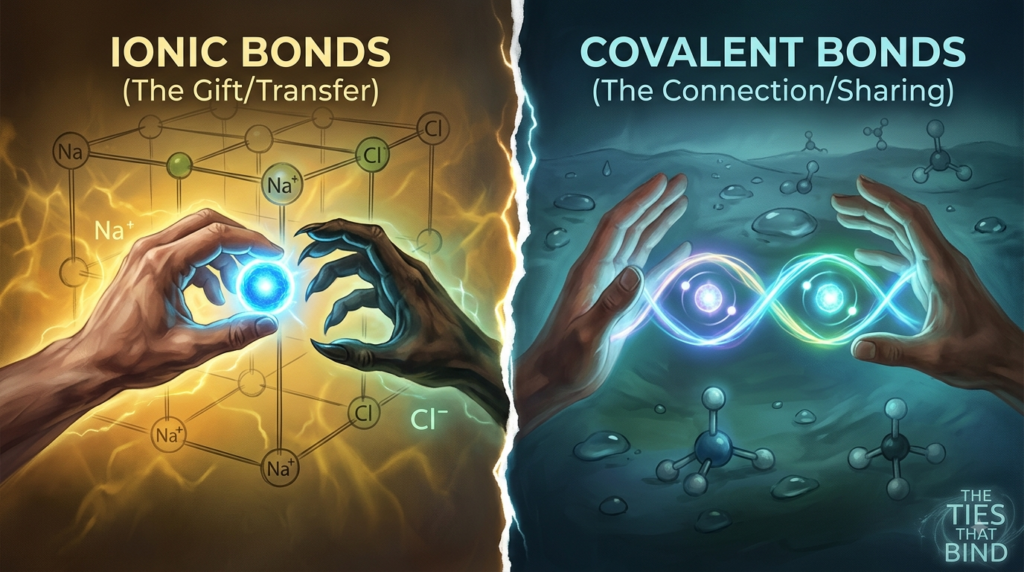

Acids, Bases, and Salts
Navigating the IB Chemistry syllabus can feel overwhelming, especially when tackling core conceptual topics like chemical equilibrium, energetics, and acid-base chemistry. Whether you are enrolled in Standard Level (SL) or Higher Level (HL), mastering IB Chemistry acids bases and salts is essential for scoring a 7 in your Paper 1 and Paper 2 examinations. Understanding these chemical species isn’t just about memorizing definitions—it’s about grasping how hydrogen ions transfer, how salts are formed, and how these principles apply to real-world industrial and biological systems.
In this comprehensive study guide, we break down the foundational concepts of acids, bases, alkalis, and salts into clear, digestible steps. By the end of this article, you will understand dissociation equations, distinguish between bases and alkalis with ease, master salt naming conventions, and appreciate fascinating real-world context like the chemistry of soap making and food preparation.
1. What is an Acid? Definitions, Dissociation, and Formulas
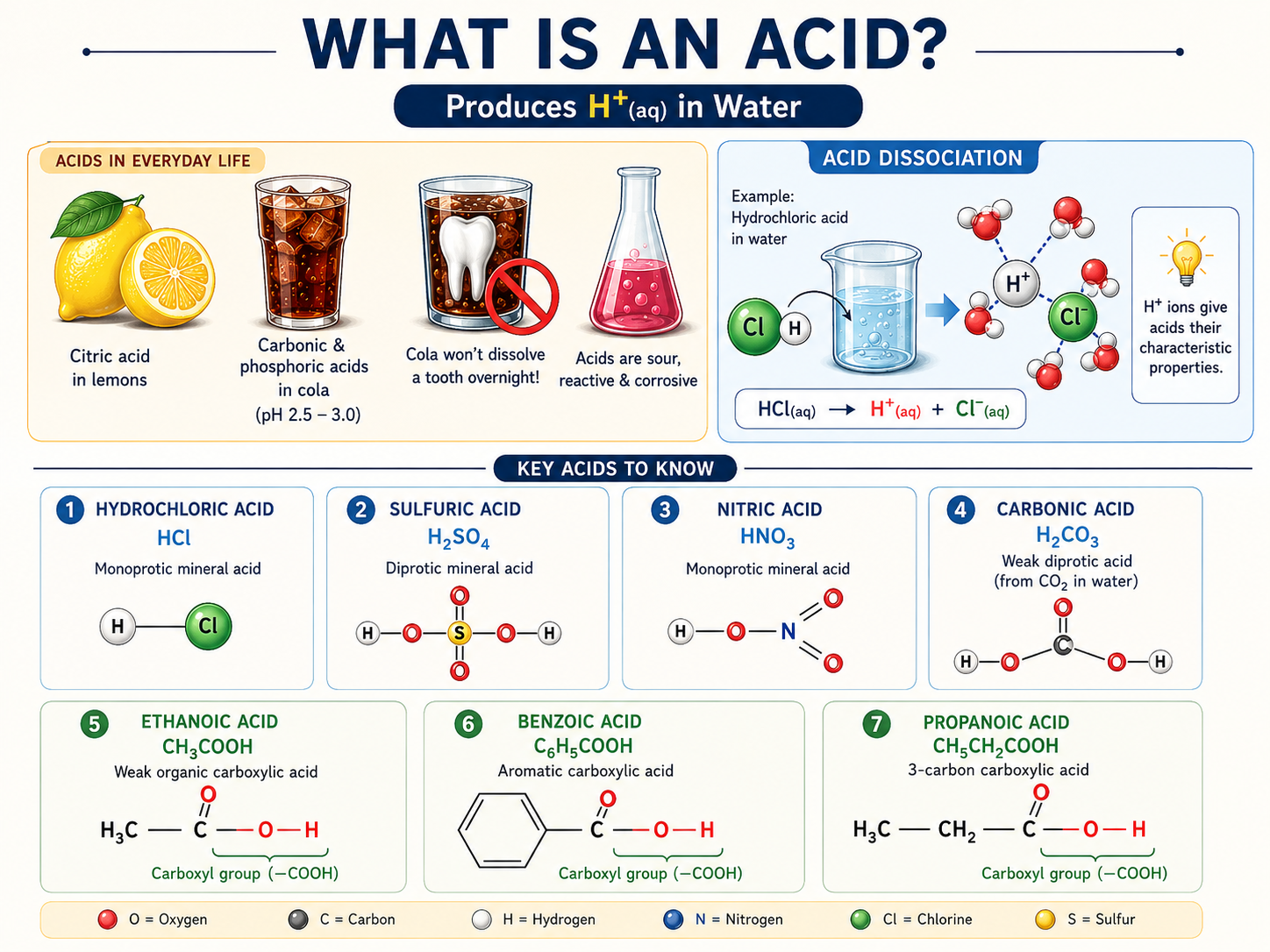
In everyday life, acids are all around us. From the citric acid in fresh lemons to the carbonic acid and phosphoric acid in a glass of cola, acidic solutions are fundamental to chemistry. In fact, a typical glass of cola has a pH ranging between 2.5 and 3.0. A common myth among chemistry students is that leaving a tooth in a glass of cola overnight will completely dissolve it—however, coke truly does not contain a high enough acid concentration for such rapid dissolution!
The Arrhenius & Fundamental Definition of Acids
At its simplest level in IB Chemistry, an acid is defined as a substance that produces hydrogen ions (H^+) when dissolved in aqueous solution. It is this single hydrogen ion (a bare proton) that gives acids their characteristic corrosive, sour, and reactive properties.
When an acid dissolves in water, it undergoes dissociation (or ionization). For example, when gaseous hydrogen chloride dissolves in water, it splits into hydrogen and chloride ions:
HCl(aq) \rightarrow H^+(aq) + Cl^-(aq)
The released H^+(aq) ions are directly responsible for the characteristic neutralisation reactions and chemical properties exhibited by all acidic solutions.
Key Acids You Must Know for IB Chemistry
IB Chemistry exams expect you to instantly recognize both mineral (inorganic) acids and organic (carboxylic) acids along with their chemical formulas. Notice that organic acids possess a carboxyl group (-COOH), where only the specific hydrogen attached to the oxygen atom is acidic and replaceable.
- Hydrochloric Acid: HCl (Monoprotic mineral acid)
- Sulfuric Acid: H_2SO_4 (Diprotic mineral acid)
- Nitric Acid: HNO_3 (Monoprotic mineral acid)
- Carbonic Acid: H_2CO_3 (Weak diprotic acid formed when carbon dioxide dissolves in water)
- Ethanoic Acid: CH_3COOH (Weak organic carboxylic acid; acidic hydrogen shown in red: CH_3COO\mathbf{H})
- Benzoic Acid: C_6H_5COOH (Aromatic carboxylic acid)
- Propanoic Acid: CH_3CH_2COOH (3-carbon carboxylic acid)
2. Bases vs. Alkalis: Key Differences and Chemical Reactions
Students often use the terms base and alkali interchangeably, but IB examiners frequently test the subtle, crucial distinction between the two.
What is a Base?
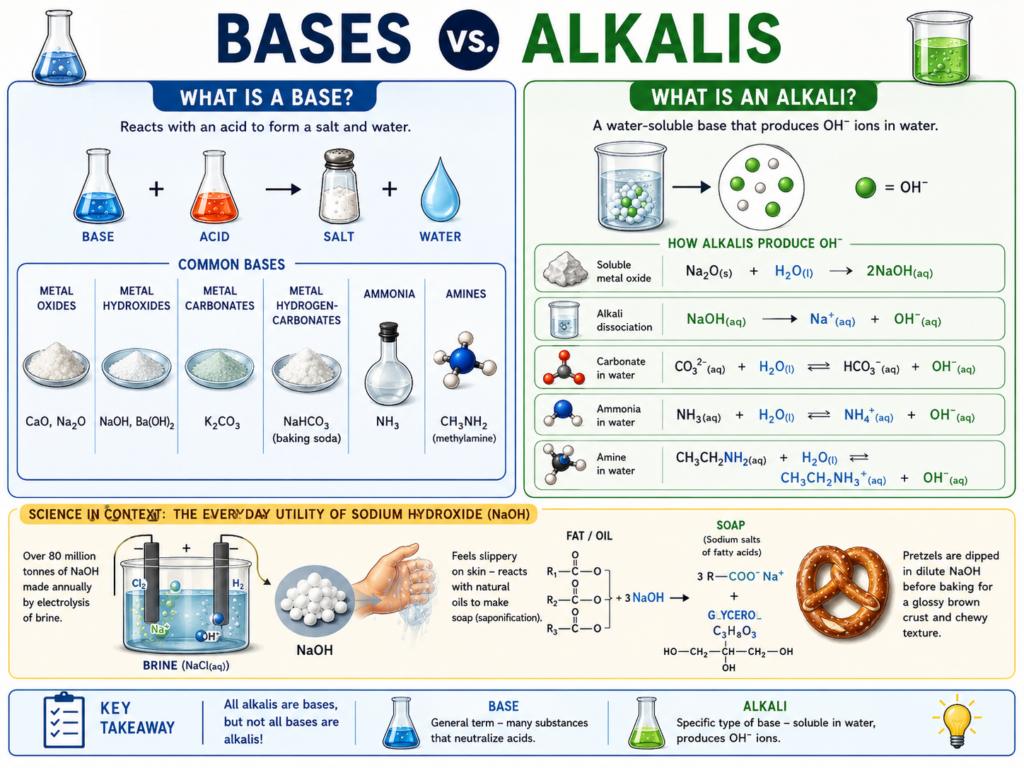
A base is a substance that reacts with an acid in a neutralisation reaction to form a salt and water. Bases can be thought of as the chemical opposites of acids. Common categories of bases include:
- Metal Oxides: e.g., Calcium oxide (CaO), Sodium oxide (Na_2O)
- Metal Hydroxides: e.g., Sodium hydroxide (NaOH), Barium hydroxide (Ba(OH)_2)
- Metal Carbonates: e.g., Potassium carbonate (K_2CO_3)
- Metal Hydrogencarbonates: e.g., Sodium hydrogencarbonate (NaHCO_3, commonly known as baking soda)
- Ammonia: NH_3
- Amines: Organic derivatives of ammonia such as methylamine (CH_3NH_2)
What is an Alkali?
An alkali is a specific subset of bases. Specifically, an alkali is a water-soluble base that dissolves in water to produce hydroxide ions (OH^-). While all alkalis are bases, not all bases are alkalis because many metal oxides and hydroxides (like copper(II) oxide) are completely insoluble in water.
When soluble metal oxides react with water, they produce alkaline hydroxide solutions:
Na_2O(s) + H_2O(l) \rightarrow 2NaOH(aq)
In solution, sodium hydroxide dissociates fully into aqueous ions:
NaOH(aq) \rightarrow Na^+(aq) + OH^-(aq)
Similarly, soluble carbonate ions and weak nitrogenous bases like ammonia react reversibly with water to generate hydroxide ions:
CO_3^{2-}(aq) + H_2O(l) \rightleftharpoons HCO_3^-(aq) + OH^-(aq)
NH_3(aq) + H_2O(l) \rightleftharpoons NH_4^+(aq) + OH^-(aq)
CH_3CH_2NH_2(aq) + H_2O(l) \rightleftharpoons CH_3CH_2NH_3^+(aq) + OH^-(aq)
Science in Context: The Everyday Utility of Sodium Hydroxide
Did you know that bar soaps and Bavarian pretzels share a common industrial ingredient? Both rely on sodium hydroxide (NaOH), commonly known as lye or caustic soda. Over 80 million tonnes of NaOH are manufactured globally each year via the electrolysis of brine (chlor-alkali industry).When NaOH touches human skin, it feels slippery or soapy. This is because it reacts immediately with the fatty oils on your skin to perform saponification—literally making soap on your hands! Industrially, fat or vegetable oil is heated with sodium hydroxide to yield soap (the sodium salt of fatty acids) and glycerol (C_3H_8O_3). On the culinary side, traditional pretzels are dipped in a dilute sodium hydroxide solution prior to baking to create their iconic glossy brown crust and chewy texture.
3. What is a Salt? Naming Rules & Chemical Equations
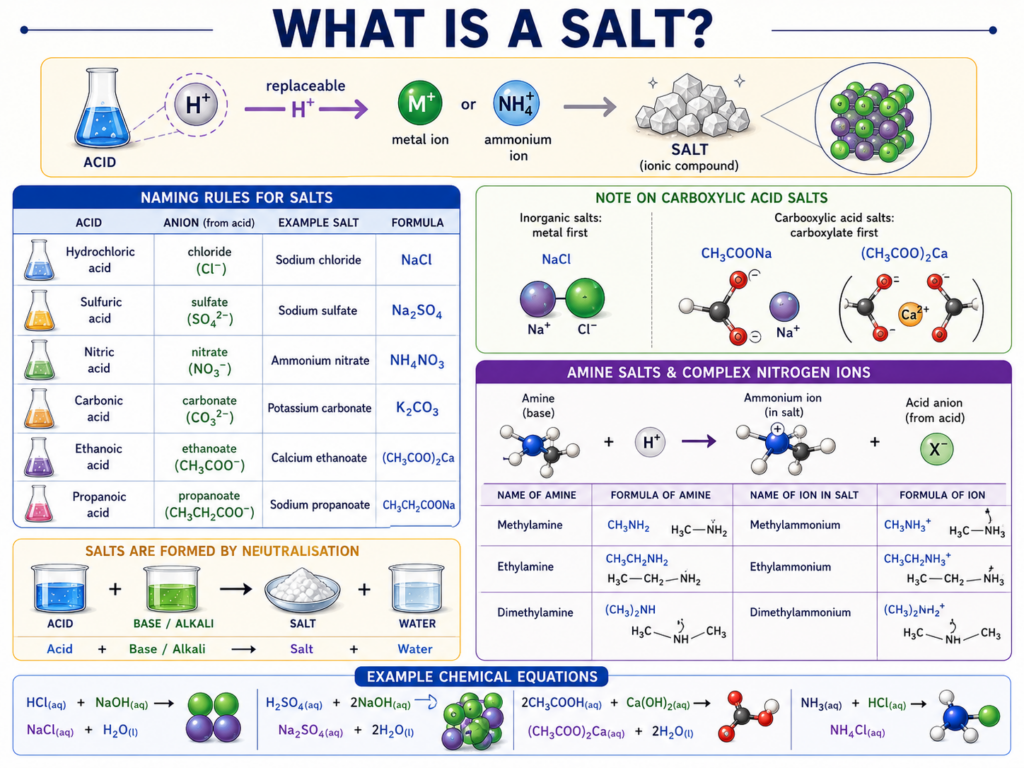
In chemistry, a salt is an ionic compound formed when the replaceable hydrogen ion (H^+) of an acid is substituted by a metal ion or an ammonium ion (NH_4^+).
Naming Rules for Salts
The name of a salt consists of two parts: the first part comes from the cation provided by the base or metal, and the second part comes from the parent acid:
- Hydrochloric acid forms chlorides (e.g., Sodium chloride, NaCl)
- Sulfuric acid forms sulfates (e.g., Sodium sulfate, Na_2SO_4)
- Nitric acid forms nitrates (e.g., Ammonium nitrate, NH_4NO_3)
- Carbonic acid forms carbonates (e.g., Potassium carbonate, K_2CO_3)
- Ethanoic acid forms ethanoates (e.g., Calcium ethanoate, (CH_3COO)_2Ca)
- Propanoic acid forms propanoates (e.g., Sodium propanoate, CH_3CH_2COONa)
Note on Carboxylic Acid Salts: In standard inorganic formulas, the metal cation is written first (e.g., NaCl). However, for salts of organic carboxylic acids, IB conventions dictate writing the organic carboxylate anion portion first, followed by the metal ion (e.g., CH_3COONa or (CH_3COO)_2Ca).
Amine Salts and Complex Nitrogen Ions
When weak nitrogenous bases like ammonia or organic amines react with acids, they gain a proton (H^+) to form positively charged cations. These cations then form salts with acid anions:
| Name of Amine | Formula of Amine | Name of Ion in Salt | Formula of Ion |
|---|---|---|---|
| Methylamine | CH_3NH_2 | Methylammonium | CH_3NH_3^+ |
| Ethylamine | CH_3CH_2NH_2 | Ethylammonium | CH_3CH_2NH_3^+ |
| Dimethylamine | (CH_3)_2NH | Dimethylammonium | (CH_3)_2NH_2^+ |
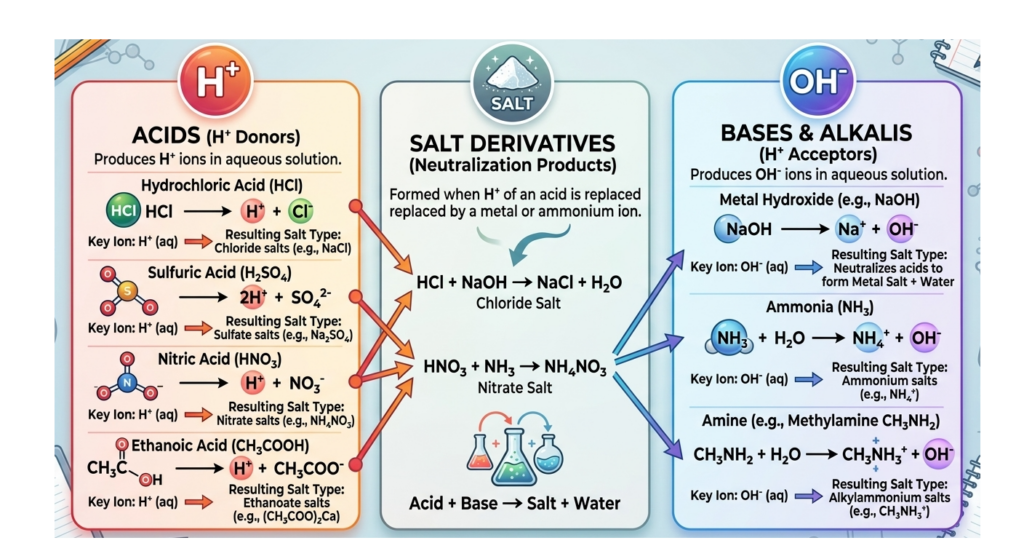
Summary Comparison Table: Acids, Bases, and Salts
To help consolidate your memory for IB Chemistry quizzes and revision, the table below provides a side-by-side comparison of major acidic and basic species, their key ions, and salt derivatives.
| Chemical Category | Formula / Example | Key Ion Produced in Solution | Resulting Salt Type / Reaction Product |
|---|---|---|---|
| Hydrochloric Acid | HCl | H^+(aq) | Chloride salts (e.g., NaCl) |
| Sulfuric Acid | H_2SO_4 | H^+(aq) | Sulfate salts (e.g., Na_2SO_4) |
| Nitric Acid | HNO_3 | H^+(aq) | Nitrate salts (e.g., NH_4NO_3) |
| Ethanoic Acid | CH_3COOH | H^+(aq) | Ethanoate salts (e.g., (CH_3COO)_2Ca) |
| Metal Hydroxide (Base/Alkali) | NaOH | OH^-(aq) | Neutralizes acids to form Metal Salt + Water |
| Ammonia (Base) | NH_3 | OH^-(aq) | Ammonium salts (e.g., NH_4^+) |
| Amine (Base) | Methylamine (CH_3NH_2) | OH^-(aq) | Alkylammonium salts (e.g., methylammonium CH_3NH_3^+) |
Key Takeaways & Next Steps
- Acids: Substances that release H^+ ions in aqueous solution. Key examples include HCl, H_2SO_4, HNO_3, and organic carboxylic acids.
- Bases vs. Alkalis: Bases react with acids to form salts. Alkalis are water-soluble bases that release OH^- ions.
- Salts: Compounds formed when the acidic proton H^+ is replaced by a metal or ammonium ion.
- Exam Tip: Pay close attention to writing correct chemical states (aq, s, l, g) and balancing charge in IB ionic equations!
Need extra guidance mastering IB Chemistry topics, perfecting your Internal Assessment (IA), or boosting your final exam performance? Contact Easy Sevens Education today to connect with expert IB tutors in Hong Kong and secure your 7!
Frequently Asked Questions (FAQ)
What is the difference between a strong acid and a weak acid in IB Chemistry?
Are all bases soluble in water?
Why are all hydrogens in ethanoic acid (CH_3COOH) not acidic?
Only the hydrogen atom attached directly to the oxygen in the carboxyl group (-COOH) is replaceable because the resulting negative charge is stabilized by resonance across the carboxylate ion (CH_3COO^-). The three hydrogens attached to the carbon in the methyl group (CH_3-) are non-polar and non-acidic.
What is the ionic equation for a classic neutralisation reaction?
How does sodium hydroxide react in soap production?
In saponification, sodium hydroxide (NaOH) reacts with natural fats/triglycerides under heat. The base cleaves the ester bonds, yielding glycerol and sodium salts of fatty acids, which serve as soap molecules with non-polar tails and polar carboxylate heads.