
If you ask an IB Physics student to recite Newton’s Third Law, they will almost instantaneously respond: "For every action, there is an equal and opposite reaction." It is the most memorable of Newton's laws, yet, ironically, it is the one that students trip up on the most during Paper 1 multiple-choice questions.
The confusion doesn't stem from the definition itself, but from applying it to real-world scenarios. When drawing a Free Body Diagram (FBD) of a book resting on a table, it is incredibly tempting to label the gravitational force (weight) and the normal reaction force as a Newton's Third Law pair. After all, they are equal in magnitude and opposite in direction. However, this is a fundamental error that costs students marks every year.
At Easy Sevens Education, we bridge the gap between memorizing definitions and deeply understanding mechanics. In this guide, we will deconstruct Newton's Third Law IB Physics concepts, clarify the difference between force pairs and equilibrium, and analyze classic scenarios like the "Truck vs. Car" collision and the "Bird in Flight" to ensure you never miss these questions again.
The Definition and The "Two-Body" Rule
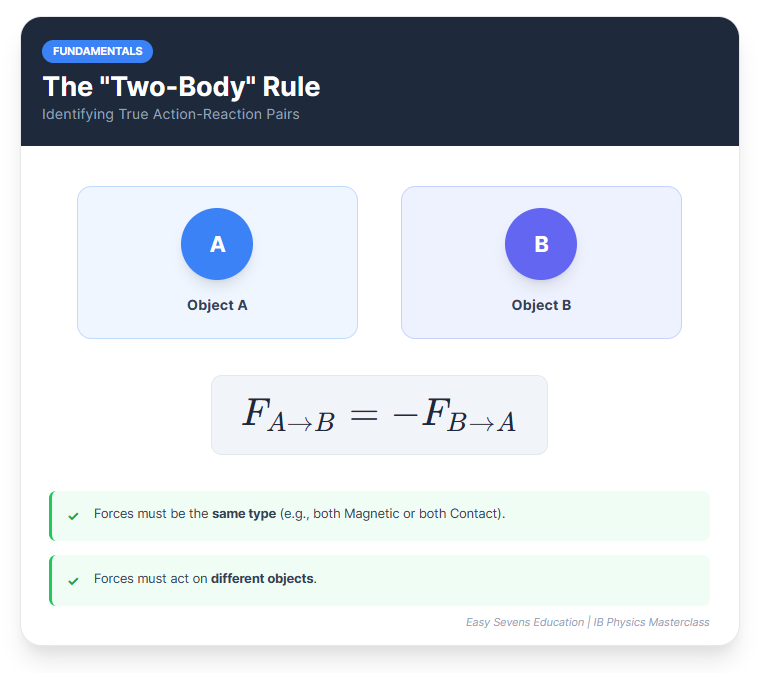
Newton's Third Law states that if Object A exerts a force on Object B, then Object B simultaneously exerts a force of equal magnitude and opposite direction on Object A. These two forces are known as an action-reaction pair (or simply a force pair).
To identify a true force pair, you must strictly adhere to the "Two-Body Rule." A Third Law pair must involve exactly the same two objects interacting. If you introduce a third object (like the ground, the air, or a table), you are likely looking at balanced forces, not a force pair.
The Notation
Mathematically, this is expressed as:
F_{A \rightarrow B} = -F_{B \rightarrow A}Where:
- F_{A \rightarrow B} is the force exerted by A on B.
- F_{B \rightarrow A} is the force exerted by B on A.
- The negative sign indicates opposite direction.
Scenario 1: The Book on the Table (The Classic Trap)
Let's address the most common misconception in IB Physics mechanics: The book resting on a table.
The Situation: A book is stationary on a horizontal table.
The Forces acting on the book:
1. Weight (W or F_g) acting downwards.
2. Normal Reaction Force (R or F_N) acting upwards.
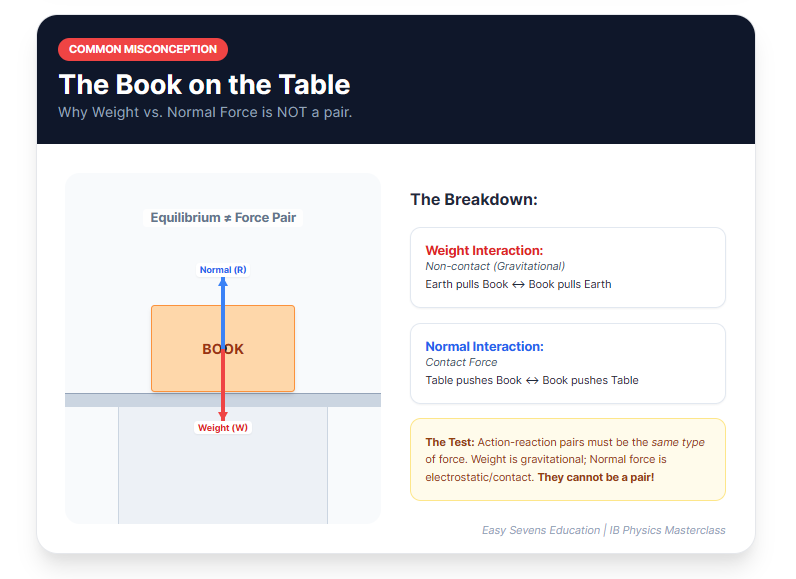
Because the book is not accelerating, Newton's Second Law tells us the net force is zero. Therefore, magnitude W = R. Because they are equal and opposite, students assume they are a Third Law pair. They are not.
Why aren't they a pair?
Remember the Two-Body Rule.
Weight is the Earth pulling the Book. (Objects: Earth, Book).
Normal Force is the Table pushing the Book. (Objects: Table, Book).
These forces act on the same object (the book). Newton's Third Law pairs must act on different objects. If you took the table away, gravity would still pull the book; the normal force is not the "reaction" to gravity.
| Feature | Newton's 3rd Law Pair (Action-Reaction) | Balanced Forces (Equilibrium) |
|---|---|---|
| Objects Involved | Acts on two different objects (A on B, B on A). | Acts on the same object. |
| Nature of Force | Must be the same type (e.g., both gravitational, both contact). | Can be different types (e.g., Gravity vs. Normal Force). |
| Result | Describes the interaction between bodies. | Results in zero acceleration ($F_{net} = 0$). |
| Example | Earth pulls Book Down; Book pulls Earth Up. | Normal Force Up cancels Weight Down. |
So, what are the actual pairs?
If we want to find the Newton's Third Law pair for the weight of the book, we simply flip the sentence:
- Action: Earth pulls Book down (Gravitational Force).
- Reaction: Book pulls Earth up (Gravitational Force).
Yes, the book pulls the Earth upwards with the exact same force. We will explain why the Earth doesn't move later in this article.
Scenario 2: The Truck vs. The Car (Collisions)
Another classic IB Physics Paper 1 question involves a massive truck colliding head-on with a small car. The question usually asks: "During the collision, how does the force exerted by the truck on the car compare to the force exerted by the car on the truck?"
The Intuitive (Wrong) Answer: The truck is bigger and heavier, so it must exert a larger force.
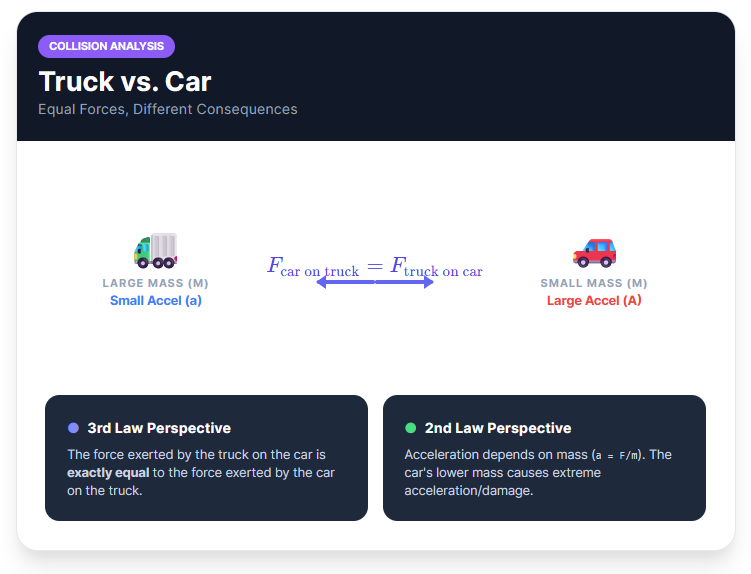
The Physics (Correct) Answer: The forces are exactly equal.
According to Newton’s Third Law, the force is an interaction. The impact is a single event shared between two bodies.
F_{truck \rightarrow car} = -F_{car \rightarrow truck}
Why does the car get destroyed?
If the forces are equal, why does the car suffer more damage and fly backward while the truck barely slows down? This is explained by Newton's Second Law (F=ma).
- The Force (F): Same for both.
- The Mass (m): The truck has a huge mass; the car has a small mass.
- The Acceleration (a): Since a = \frac{F}{m}, the smaller mass (car) experiences a massive acceleration (change in velocity), while the larger mass (truck) experiences a tiny acceleration.
Scenario 3: The Bird in Flight
Consider a bird flying horizontally. One of the forces acting on the bird is its weight (W) downwards. A common exam question asks to identify the Third Law pair to this weight.
Options often include:
A) The lift force of the air pushing the bird up.
B) The bird pushing the air down.
C) The bird pulling the Earth up.
Analysis:
Option A and B involve the air. Weight has nothing to do with air; weight is the interaction between the Bird and the Earth. Therefore, the pair must be the Bird pulling the Earth up. The interaction with the air (Lift) is a separate pair:
1. Wings push air down.
2. Air pushes wings up (Lift).
Gravitational Attraction: Why You Pull the Earth
Students often struggle with the idea that they are pulling the Earth upwards. If you jump off a chair, you fall towards the Earth. Is the Earth rising to meet you?
Technically, yes. You and the Earth are pulling on each other with the exact same gravitational force, defined by Newton's Law of Universal Gravitation:
F = G \frac{M m}{r^2}Where M is the mass of Earth and m is your mass. Whether you calculate the force from the Earth's perspective or your perspective, the product Mm is the same. The force is identical.
The "Sucking" Analogy
Think of gravity as the Earth "sucking" you down to the floor. Simultaneously, you are "sucking" the Earth upwards. However, because the Earth’s mass is approximately 5.97 \times 10^{24} kg, the acceleration caused by your tiny gravitational pull is negligible—so small it is effectively zero (0.000...1 m/s^2). You, however, with a mass of 60-80kg, experience a noticeable acceleration of 9.81 m/s^2.
Related Resources
Mastering mechanics requires connecting Newton's laws to other areas of physics, such as kinematics and momentum. To deepen your understanding, explore our guides on IB Physics Tutors who can provide personalized feedback on your Free Body Diagrams. Additionally, ensuring your data analysis skills are sharp is crucial for your Internal Assessment; check out our overview of IB Physics Internal Assessment Guides for tips on error propagation and uncertainties.
Frequently Asked Questions
Does the weight of a book change if I push down on it?
No, the weight of the book does not change. Weight is calculated as W=mg. Unless the mass of the book changes or you transport the book to a different planet (changing g), the weight remains constant. Pushing down on the book increases the normal reaction force from the table, but it does not change the gravitational pull of the Earth on the book.
Is Normal Force always equal to Weight?
No. Normal force is a “smart” force—it adjusts to whatever is necessary to keep surfaces from passing through each other. If a book is on a flat table with no other forces, N = W. However, if you push down on the book with 5N of force, the table must push back harder to resist. In that case, N = W + 5N. If the surface is inclined (a ramp), N = W \cos(\theta).
Why don't action and reaction forces cancel each other out?
Does Newton's Third Law apply to objects in motion?
Yes. Newton’s Third Law applies regardless of whether objects are stationary, moving at constant velocity, or accelerating. When a sprinter accelerates, they push the ground backward, and the ground pushes them forward. These forces are equal and opposite, even though the sprinter is accelerating forward.
How do I represent Third Law pairs in a Free Body Diagram?
Conclusion
Newton's Third Law is simple to say but requires discipline to apply. The key to avoiding "traps" in IB Physics is to slow down and identify the two bodies involved in the interaction. Remember:
- Action-reaction pairs always act on different objects.
- Weight and Normal Force are rarely a pair.
- Big things and small things hit each other with the exact same force.
If you are struggling to visualize these forces or find yourself constantly confusing weight and mass, you are not alone. Physics is a conceptual subject that often requires a dialogue to master. At Easy Sevens Education, our tutors specialize in turning these abstract concepts into intuitive logic.
Ready to turn your 4 into a 7? Contact Easy Sevens Education today to schedule a session with a mentor who knows the IB curriculum inside and out.